Introduction
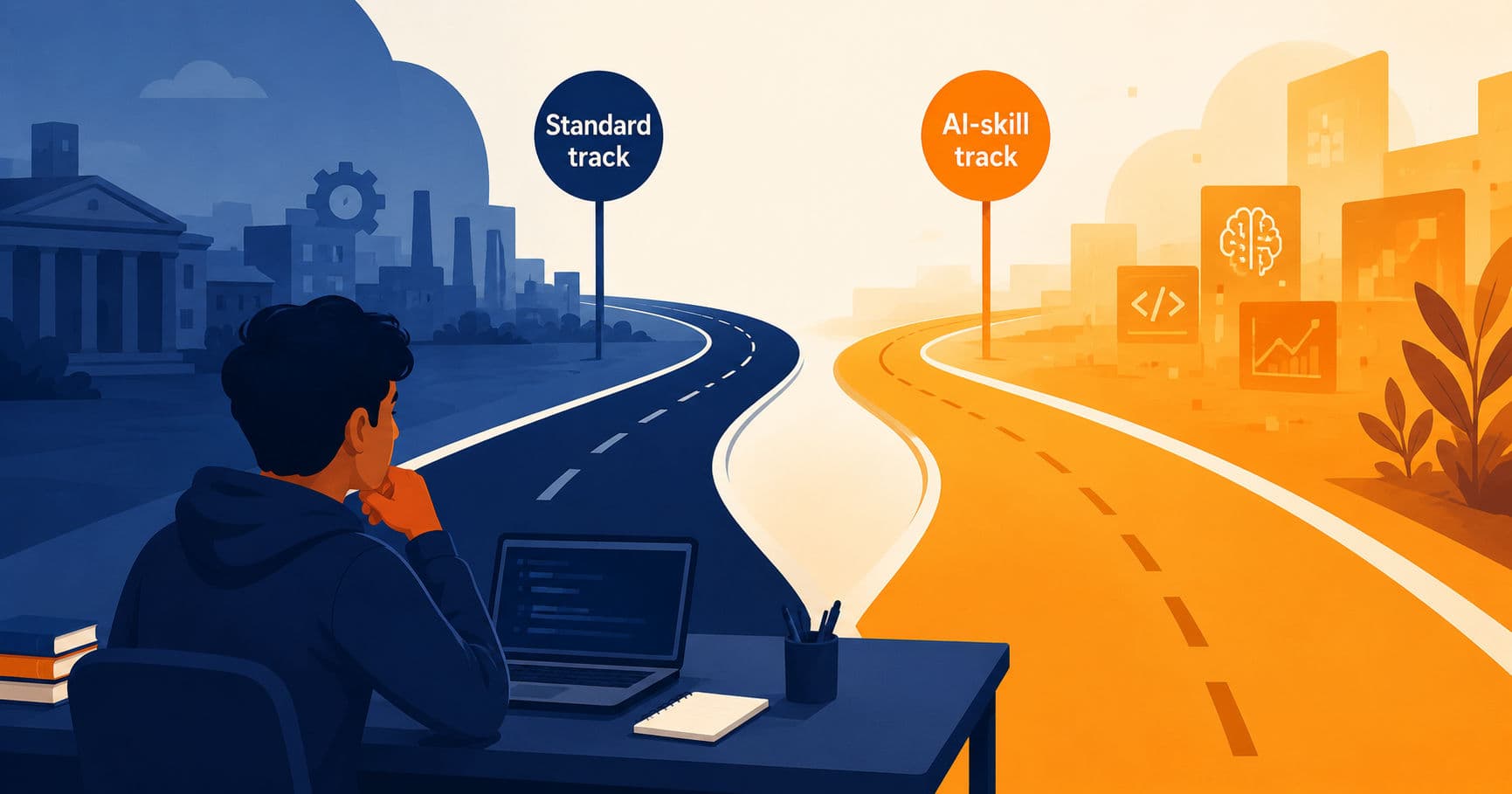
If you're an engineering student applying for developer roles this year, you've probably noticed something strange: job postings that used to ask for "strong coding fundamentals" now ask for "experience working with AI coding tools." This isn't a small trend. It's a structural shift in what companies expect from junior developers, and it's happening faster than most college curriculums can keep up with.
In 2026, more than half of the code committed to GitHub is either generated or substantially assisted by AI tools. At the same time, several major companies have slowed down junior hiring altogether. Put those two facts together, and the message is clear: writing code is no longer the scarce skill. Knowing how to work with AI to produce reliable, well-judged code is.
This article breaks down what "AI-native" actually means, why it's becoming a hiring requirement, and exactly how you can build this skill set before you graduate.
Table of Contents
1. What "AI-Native" Actually Means
- Why Companies Are Changing Junior Hiring Standards
- The Skills Gap Nobody Warned You About
- How to Become an AI-Native Developer (Practical Roadmap)
- Common Mistakes Students Make with AI Tools
- How HelloEngineers Helps You Bridge This Gap
- FAQ
- Conclusion
What "AI-Native" Actually Means
Being AI-native doesn't mean you can write a good ChatGPT prompt. It means AI tools are part of how you think through a problem, not a shortcut you reach for when you're stuck.
An AI-native developer can:
Direct an AI coding agent through a multi-step task (read a codebase, plan changes, run tests) rather than just asking for a single function
Spot when AI-generated code is subtly wrong a common off-by-one error, a security gap, or an architecture choice that won't scale
Combine AI output with their own understanding of data structures, algorithms, and system design Move faster than a non-AI-native peer without sacrificing code quality
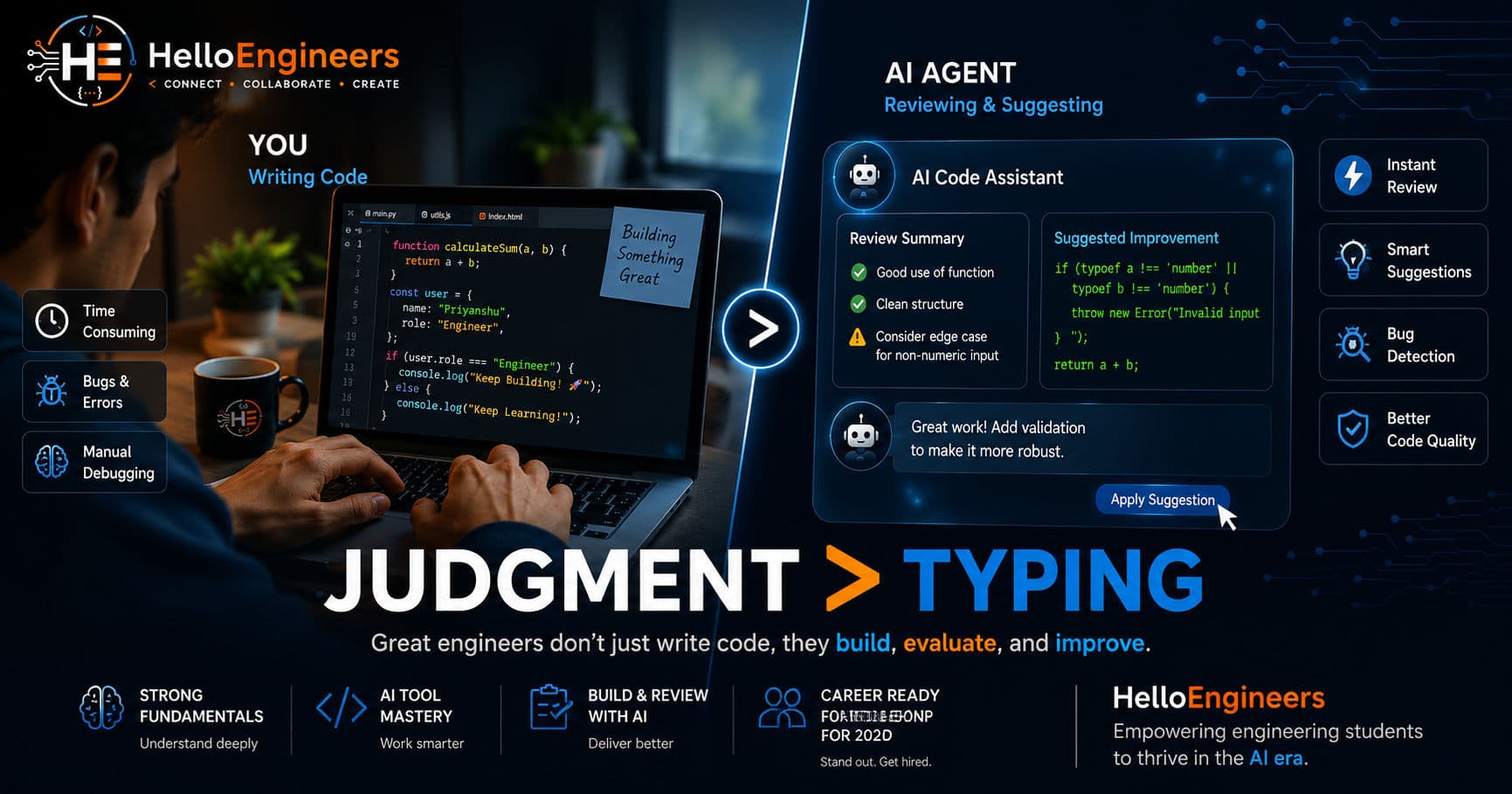
In short, the AI does the typing. You do the thinking. That distinction is now the actual interview bar.
Why Companies Are Changing Junior Hiring Standards
For years, junior developer roles existed partly to train people up — you wrote boilerplate, fixed small bugs, and slowly built judgment. AI coding agents now handle a lot of that boilerplate work instantly, which has two effects on hiring:
-
Fewer purely "entry-level" tasks exist. If an AI agent can generate a CRUD API in minutes, companies don't need a junior developer just to do that.
-
The bar for what counts as "junior-ready" has moved up. Employers now expect junior developers to review, validate, and improve AI-generated solutions — a skill that used to be expected only of mid-level engineers.

This is why some companies have publicly paused junior hiring while simultaneously posting roles that explicitly ask for AI-tool fluency. They're not hiring fewer people because they need less help — they're hiring more selectively for people who can add judgment on top of AI output from day one.
The Skills Gap Nobody Warned You About
Most engineering curriculums still teach coding the way it was taught a decade ago: write code from scratch, debug manually, submit for review. That's not wrong — fundamentals still matter enormously, but it leaves a gap.
Students often graduate strong on theory but with zero experience:
Directing an AI agent through a real, messy codebase
Reviewing AI-generated pull requests critically
Knowing when not to trust an AI suggestion
Working inside a multi-agent workflow, where different AI tools handle different parts of a project
This gap is exactly what shows up in interviews now, especially in take-home assignments and live coding rounds where AI tool usage is allowed or even expected.
How to Become an AI-Native Developer (Practical Roadmap)
Here's a step-by-step approach you can start this week:
1. Master the fundamentals first
AI tools amplify what you already know. If you don't understand data structures, system design basics, or how to debug logically, you won't be able to catch AI's mistakes. Don't skip this step to "save time" — it backfires in interviews.
2. Learn AI coding tools properly
Go beyond autocomplete. Spend real time with tools like GitHub Copilot, Cursor, or Claude Code. Learn how to:
Give an agent a multi-step task and review its plan before it executes Ask it to explain its reasoning, not just produce output Use it for debugging and code review, not only code generation
3. Build projects that show judgment, not just output
Instead of "I built an app with AI," aim for "I directed an AI agent to build a feature, caught two bugs in its output, and fixed a scalability issue it missed." That story is what gets you hired.
4. Practice explaining code, not just writing it
In interviews, be ready to walk through why a piece of code works, including AI-generated code. Employers are testing your judgment, not your typing speed.
5. Contribute to open source or real projects
Working on an existing codebase — even a small one — teaches you to review and integrate code, which is closer to what junior roles actually look like now.
Common Mistakes Students Make with AI Tools
Treating AI as a black box. Copy-pasting output without understanding it is the fastest way to fail a technical interview. Avoiding AI tools entirely out of fear of "cheating." This just means you show up less prepared than peers who used the time to build real workflow skills. Never testing AI-generated code. Always run it, break it, and understand its edge cases. Ignoring fundamentals. AI can't replace understanding — it exposes the gap faster when you don't have it.
How HelloEngineers Helps You Bridge This Gap
At HelloEngineers, we work with engineering students across India to close exactly this gap — through project-based learning, mentorship, hackathons, and career guidance that reflects how the industry actually hires today, not how it hired five years ago. If you're preparing for internships or your first developer role, building AI-native habits now is one of the highest-leverage things you can do before you graduate.
Conclusion
The developers who thrive in 2026 and beyond won't be the ones who avoid AI, and they won't be the ones who blindly trust it either. They'll be the ones who know exactly when to lean on it and when to override it. That judgment is built through practice, not shortcuts — starting with strong fundamentals and deliberate, hands-on use of AI tools in real projects.
If you're a student reading this, the best time to start building that habit is now, while you still have room to experiment before your first real interview.
FAQ
Q: Does being "AI-native" mean I don't need to learn to code manually?
No. Fundamentals are more important than ever, because they're what let you judge AI output correctly. AI amplifies skill — it doesn't replace it.
Q: Will AI tools eliminate junior developer jobs completely?
Not entirely, but they are reshaping what junior roles look like. Purely repetitive coding tasks are shrinking; roles that require judgment, review, and integration skills are growing.
Q: Which AI tools should students learn first?
Start with widely used ones like GitHub Copilot or Cursor for coding, and an agentic tool like Claude Code to practice directing multi-step tasks. Familiarity with the workflow matters more than the specific tool.
Q: How do I show AI skills on my resume or in interviews?
Talk about specific outcomes: what you built, how you used AI in the process, and — most importantly what you caught or improved that the AI got wrong.