Is AI replacing engineers in India right now?
AI is not replacing engineers in India in any measurable sense at the aggregate level. The volume data says the opposite of what the headlines say.
NASSCOM's Strategic Review 2026 projects direct tech-sector employment reaching roughly 6 million in FY26, a net addition of about 135,000 people and a 2.3% rise year on year. That is slower than the hiring booms of 2021 and 2022, and the slowdown is real. It is not a contraction.
Company-level numbers point the same way. As reported by The Hans India in July 2026, TCS onboarded about 14,000 freshers in the April–June quarter with a stated plan of around 25,000 for the financial year, and its CEO said directly that AI would not replace engineers. Infosys hired about 4,000 campus freshers in the June quarter against a full-year target near 20,000.
Two honest caveats belong here. First, hiring pace has slowed relative to revenue growth, which means each rupee of revenue now supports fewer new jobs than it did three years ago. Second, NASSCOM's own Roadmap for Job Creation in the AI Economy frames India as sitting between a potential 1.5 million job loss by 2031 and a 2.5 million job gain, depending on how the industry and its workforce respond. The outcome is not decided.
So the accurate statement is narrow: engineering as a profession is not being replaced, entry-level tasks are being automated fast, and the offer you receive now depends on which of those two facts describes your profile.
Why fresher hiring has split into two salary tracks
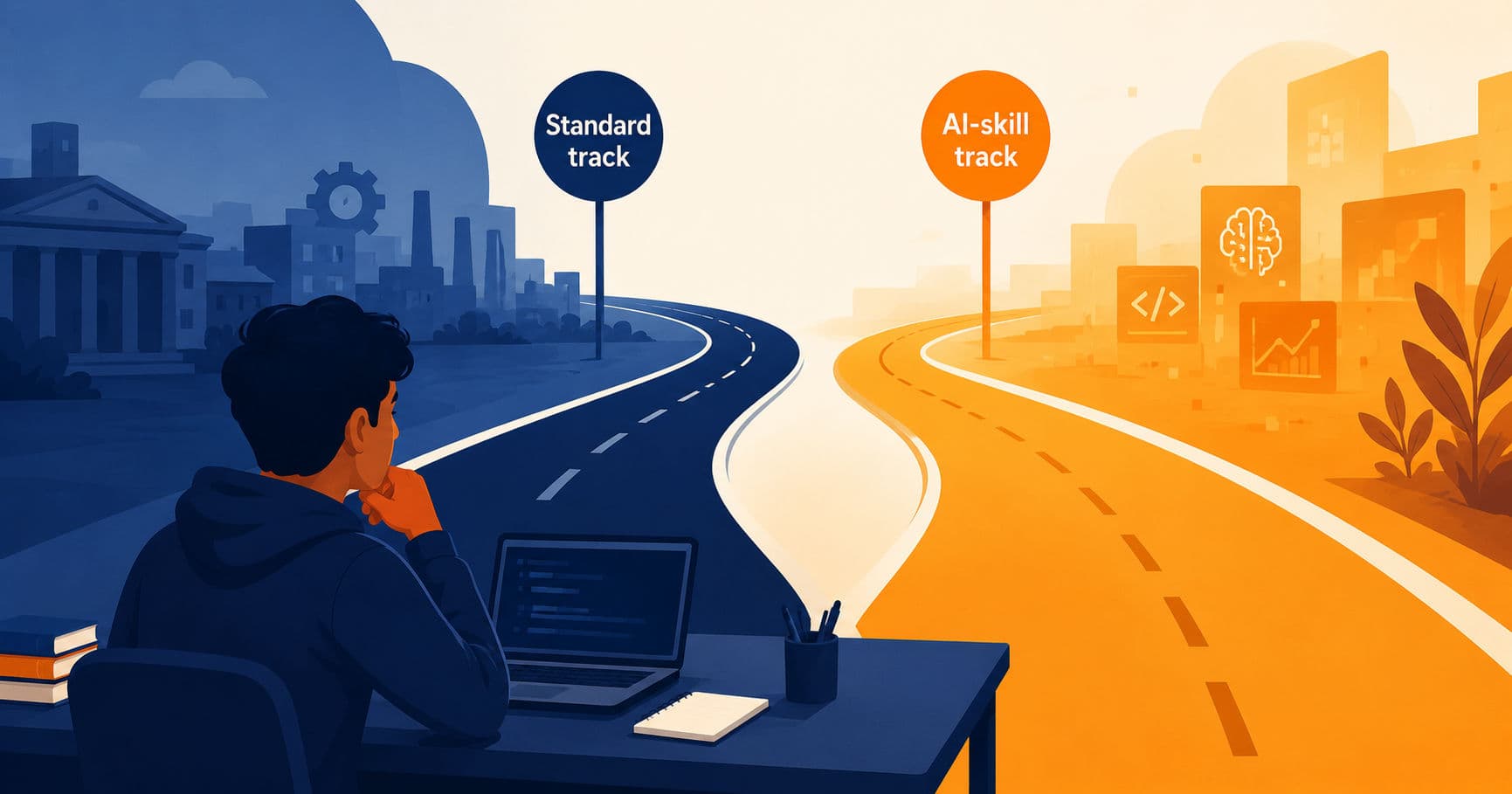
Fresher hiring in Indian IT now runs on two tracks with a gap between them wider than anything the market had five years ago.
The standard track is the traditional mass-hiring pipeline: aptitude test, basic coding round, service-company training, project allocation. Packages commonly reported here start around ₹3.4–4.2 LPA for entry-level roles at large IT services firms, with higher bands (TCS Digital and Prime, Infosys Specialist Programmer) for stronger test scores. Check your own offer letter rather than any blog, including this one, because bands shift each cycle.
The premium track is new. Per The Hans India's August 2026 reporting, Infosys has begun paying annual compensation up to ₹21 lakh to freshers with advanced AI skills, and HCLTech is offering ₹18–22 lakh to freshers who can solve complex problems with those skills. Mid-tier firms have started matching in narrower bands.
That is a five-to-six times spread inside the same graduating batch, at the same colleges, in the same season.
| Track | Typical fresher band | What gets you in |
|---|---|---|
| Standard IT services | ₹3.4–7 LPA | Aptitude test, DSA basics, degree |
| Product / GCC | ₹6–14 LPA | Strong DSA, system fundamentals, projects |
| AI-skill premium | ₹18–22 LPA | Deployed AI work plus solid engineering fundamentals |
The takeaway: the premium track is not a different degree or a different college. It is the same graduate carrying one extra category of evidence.
Demand data supports the split. Naukri's JobSpeak index for January 2026 recorded overall fresher hiring up 8% year on year while AI and ML roles rose 34%, with the broader IT sector flat for the month. Fresher demand did not fall. It concentrated.
Which fresher tasks has AI already absorbed?
AI has absorbed the specific tasks that used to make a first-year engineer useful, which is why "I can code" no longer functions as a differentiator in an interview.
Here is the task-level picture rather than the usual role-level list.
| Fresher task | Status in 2026 | What now signals value instead |
|---|---|---|
| CRUD endpoints, scaffolding | Absorbed | Schema design, failure handling |
| Standard bug fixes | Absorbed | Reproducing and isolating unclear bugs |
| Documentation, comments | Absorbed | Writing a design note before coding |
| Simple SQL, reports | Absorbed | Query performance and data modelling |
| Unit test generation | Mostly absorbed | Deciding what is worth testing |
| Feature work from a spec | Assisted | Judging the spec, catching gaps |
| Integration and edge cases | Assisted | Debugging across system boundaries |
| Deploying and running a system | Barely assisted | Doing it end to end, once, yourself |
The pattern across the table: AI is strong wherever the problem is already fully specified, and weak wherever the work is deciding what the problem actually is. Your placement preparation should sit on the second side of that line.
This is also why campus screening changed shape. When a recruiter can generate a working CRUD app in four minutes, a CRUD app on your resume proves nothing about you. It proves the tool works.
What do Indian recruiters screen for in the 2026 campus season?
Indian recruiters in the 2026 season are screening for evidence that you can operate a system, not evidence that you can produce code.
From what the HelloEngineers team sees while reviewing student projects submitted by our community of engineering students in India, four checks come up again and again:
- Can you explain your own code? The most common interview failure this year is a candidate who cannot walk through a function in their own repository. Interviewers now open the file and ask.
- Does the project run? A deployed URL, even on a free tier, beats a polished README. Anything the interviewer can click carries more weight than anything they have to imagine.
- Is there a commit history? A repository where every file arrives in one commit two days before the deadline reads as generated, whether or not it was. Twenty commits over three weeks reads as built.
- Can you describe a failure? "What broke and how did you find it" is the question that separates candidates who ran a system from candidates who watched one get generated.
None of the four requires a paid course, a Tier-1 college, or a strong placement cell. All four require you to have actually built something and kept the receipts.
There is a fifth, softer signal: whether you can talk about AI tools without either pretending you avoid them or admitting you outsourced your thinking. Recruiters expect you to use AI. They are checking whether you supervised it.
What AI still cannot do on your placement project
AI cannot supply the things a placement interview is actually testing, which is why an AI-generated project rarely survives fifteen minutes of questioning.
- Judgement about requirements — deciding what to build and what to leave out, given a deadline and an incomplete brief.
- Context that lives outside the codebase — why your college's attendance rules make a naive schema wrong, what your users actually do.
- Ownership of failures — production debugging, where the symptom and the cause are in different services.
- Trade-off reasoning — explaining why you chose Postgres over MongoDB in your case, not in general.
- Consequences — an AI does not care if the deploy breaks at 2am. The person hiring you is buying someone who does.
Honest limitation on the other side, too: none of this makes fundamentals optional. AI has raised the floor on what counts as a decent project, so a weaker project than last year's now fails the same screen. The bar moved up. That is the actual cost of this shift to a fresher, and no amount of reassurance changes it.
The 30-Day AI-Proof Placement Checklist
Copy this into a notes app and tick items off. It assumes about ten hours a week, no paid tools, and no prior AI experience. It will not make you an AI engineer in a month. It will produce one defensible artefact and the vocabulary to discuss it, which is what the premium track screens for.
Week 1 — Fix the foundation (10 hours)
- Pick one existing project of yours and get it running on a free host (Render, Vercel, Railway or Fly.io free tiers). Note the deployed URL.
- Read your own code and write a 10-line design note: what it does, the data model, one thing you would change.
- Add a README with setup steps someone else can follow without asking you a question.
- Open your GitHub and check the commit pattern. If everything is one commit, do the next project differently rather than faking history.
- Write down three bugs you have personally fixed and what the symptom was. These become interview answers.
Week 2 — Learn the AI layer that freshers are hired for (10 hours)
- Learn what an LLM API call actually is: request, prompt, response, token cost. One afternoon, no course needed.
- Call any model API from a script in your own language. Print the response. That is the whole first milestone.
- Learn what RAG (retrieval-augmented generation) means: chunk documents, embed them, retrieve the relevant ones, pass them to the model with the question.
- Build the smallest possible RAG over five of your own PDFs. Accuracy does not matter yet, the pipeline does.
- Write down where it failed. Wrong chunk retrieved? Model ignored the context? These notes are the interview gold.
Week 3 — Build one project properly (12 hours)
- Pick one spec from the three below. Do not pick two.
- Commit at least four times a week, with messages that describe the change.
- Handle one failure case explicitly: API down, empty result, rate limit. Show the user something sensible.
- Add a way to evaluate output quality, even a manual sheet of 20 test questions with pass or fail marked by you.
- Deploy it. A working free-tier URL is the deliverable, not the repo.
Week 4 — Package it for the recruiter (8 hours)
- Rewrite your resume project line as: what it does, what you built, one number. "RAG assistant over 300 college notices, 20-question eval at 85% correct, deployed on Render."
- Record a two-minute screen walkthrough. Link it in the README.
- Prepare answers to five questions: why this stack, what broke, what you would change at 10x scale, where the AI helped, where you overrode it.
- Draft your AI-usage answer in advance. Something like: "I used Copilot for boilerplate and wrote the retrieval and evaluation logic myself, because that is where the mistakes were expensive." Adapt it to what is true for you.
- Put the deployed link on your resume, LinkedIn headline, and GitHub profile README.
Three project specs that move you to the premium track
Pick one. Each is scoped to fit Week 3 above and each produces something an interviewer can click.
Spec 1 — College notice assistant (RAG, easiest entry)
Build: A search box that answers questions over your college's notices, exam schedules and circulars. Data: 100–300 real PDFs or pages from your own college site. Acceptance criteria: answers cite the source document; 20-question evaluation sheet with your pass or fail marks; handles "no relevant notice found" without inventing an answer. What it proves: retrieval, grounding, and the discipline to measure output quality.
Spec 2 — Resume screener with an honest failure report (evaluation focus)
Build: A tool that scores resumes against a job description and explains each score. Data: 30 anonymised resumes from friends, with permission, or public samples. Acceptance criteria: documented rubric; a written note on where the model was unfair or wrong; a rate-limit and empty-input path that does not crash. What it proves: evaluation thinking and awareness of model bias, which very few fresher portfolios show.
Spec 3 — Agent that files something for you (integration focus)
Build: A small agent that takes an instruction and completes a multi-step task against a real API, such as creating a GitHub issue from a bug description or logging an entry to a sheet. Acceptance criteria: the agent asks for confirmation before any write action; every step is logged; one deliberate failure case is demonstrated in your walkthrough video. What it proves: tool use, guardrails, and the judgement to stop an automated action, which is exactly the supervision skill the premium track pays for.
Best practices for using AI without hollowing out your skills
- Write the design note before you prompt. If you cannot describe the data model in your own words, you cannot review what comes back.
- Type the core logic yourself. Use generation for boilerplate. The part you will be interviewed on is the part you should write.
- Read every generated line before committing. The commit is your signature, not the tool's.
- Learn the error, not just the fix. When AI resolves an error, spend two minutes on why it happened. That is the difference between one year of experience and one month repeated twelve times.
- Keep a failure log. Every bug, cause and fix in one file. This becomes your interview answer bank and takes ten seconds per entry.
- Verify anything with a number in it. Model output on salaries, cutoffs and versions goes stale and is confidently wrong. Check the primary source.
- Ship small and often. Four commits a week for three weeks reads as real work, because it is.
Common Mistakes
| Mistake | Why it happens | Fix |
|---|---|---|
| Listing "AI/ML" on the resume with no artefact | Advice everywhere says "learn AI", nobody defines the proof | Replace the skill line with one deployed project link |
| Submitting a generated project as your own build | Deadline pressure late in the semester | Build smaller, commit steadily, keep the walkthrough video |
| Learning five frameworks, finishing zero projects | Tutorial content is infinite, deadlines are not | One spec, one month, deployed |
| Avoiding AI tools entirely to "stay pure" | Fear that using tools weakens fundamentals | Use tools, write the core logic yourself, review every line |
| Chasing the ₹21 lakh headline package | The number is real, the base rate is not stated | Treat premium offers as an upside, keep DSA and core prep running |
| Ignoring aptitude and DSA prep | Assumption that AI skills replace the screening test | The test still gates the interview at most service companies |
Frequently Asked Questions
Is AI replacing engineers in India in 2026?
No. NASSCOM's Strategic Review 2026 projects net addition of around 135,000 tech jobs in FY26, with total employment near 6 million. What has changed is that routine entry-level coding tasks are automated, so screening now favours candidates who can show a working system rather than only working code.
Are IT companies still hiring freshers this year?
Yes. TCS onboarded roughly 14,000 freshers in the April–June 2026 quarter with about 25,000 planned for the financial year, and Infosys is targeting roughly 20,000 in FY27. Volumes are healthy but slower than the 2021–22 peak, and selection criteria have tightened noticeably at the entry level.
Is it still worth learning to code in India in 2026?
Yes, with a change of emphasis. Writing syntax is now cheap; understanding systems is not. Learn enough programming to design a data model, debug across services and judge a trade-off. Those skills decide fresher offers in 2026, and no current AI tool supplies them for you.
Do freshers with AI skills really get higher packages?
Some do. Reported in August 2026, Infosys has offered annual compensation up to ₹21 lakh to freshers with advanced AI skills and HCLTech ₹18–22 lakh. These are selective offers, not the batch average, so treat them as the ceiling of the premium track rather than an expected outcome.
Which engineering jobs are safest from AI right now?
The roles least exposed are those where the work is deciding what to build: system design, security engineering, infrastructure and MLOps, and any domain-heavy software where regulation or context matters. At fresher level, no role is fully safe, but candidates who can operate and debug a deployed system are the hardest to substitute.
Will campus placements reduce because of AI?
Campus volumes have moderated rather than collapsed, and Deloitte's Campus Workforce Trends work has recorded hiring returning alongside rising GenAI use in the recruitment process itself. Expect fewer mass-hire seats and more skill-gated ones, which raises the value of a differentiated project on your resume.
How do I get AI experience without a job or an internship?
Build and deploy one small project over three to four weeks: a retrieval assistant over documents you already have, with an evaluation sheet and a public URL. Free tiers cover hosting and model access for a project this size. The deployed link functions as your experience during screening.
Should I say I used AI tools in my interview?
Yes, and be specific about the boundary. Say which parts were generated, which parts you wrote, and why you drew the line there. Recruiters in 2026 assume tool use; what they screen for is whether you reviewed the output. Denying use is the answer that costs offers.
Conclusion
The honest position on AI replacing engineers in India: the profession is intact, the entry-level task list is not, and the pay gap between the two fresher tracks is now the largest it has ever been. Volume hiring continues at TCS and Infosys while a narrow premium track pays several times more for evidence most candidates do not have.
You cannot control the market. You can control whether, thirty days from now, you have one deployed project, a commit history that looks like work, and five prepared answers about what broke. Start with the checklist above, pick one spec, and ship it before your campus season opens.
Join Free Hello Engineers