C++ vs Java vs Python: Which Language Should You Learn First?
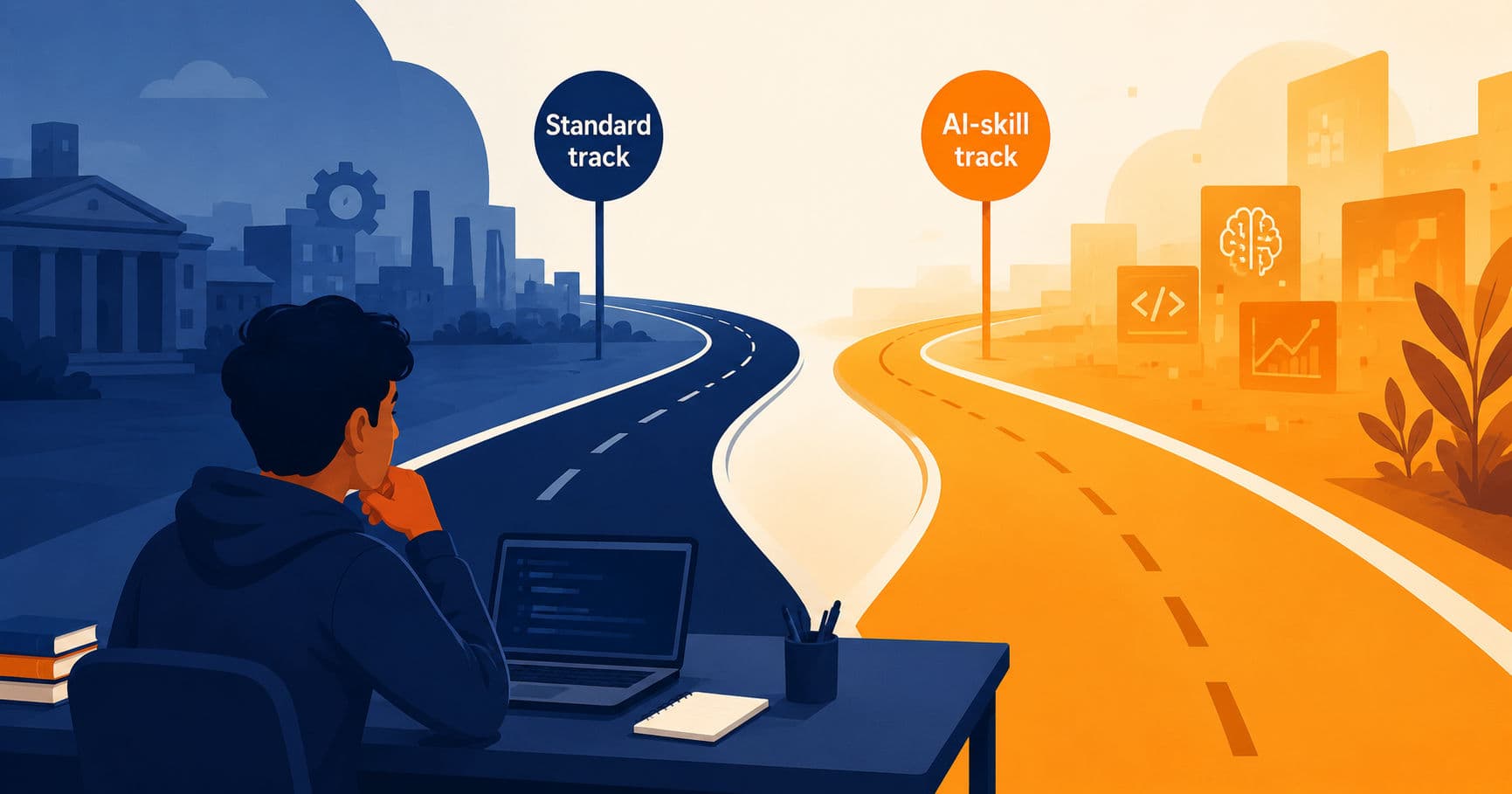
If you have searched "which programming language should I learn first," you have probably seen the same three names: C++, Java, and Python. Every senior in your college group has an opinion, and every YouTube video promises "the only language you need."
Here's the truth: there is no single "best" programming language, only the best language for your goal and timeline. This guide compares C++, Java, and Python across every dimension that matters in 2026 — syntax, learning curve, performance, memory management, OOP, careers, salary, community, and real industry use — so you can decide based on facts.
Table of Contents
- Quick Overview: C++ vs Java vs Python at a Glance
- Syntax and Readability
- Learning Curve: Which Is Easiest for Beginners?
- Performance and Speed
- Memory Management
- Object-Oriented Programming Support
- Real-World Applications
- Career Opportunities and Interview Demand in 2026
- Salary Potential in 2026
- Community Support and Ecosystem
- Industry Adoption in 2026
- Pros and Cons of Each Language
- Which Language Should You Learn First? (By Learner Type)
- Learning Roadmaps
- Free Resources to Learn C++, Java, and Python
- Project Ideas for Beginners
- Common Mistakes to Avoid
- FAQs
- Final Recommendation
Quick Overview: C++ vs Java vs Python at a Glance
| Feature | C++ | Java | Python |
|---|---|---|---|
| Type | Compiled, multi-paradigm | Compiled to bytecode, runs on JVM | Interpreted, multi-paradigm |
| Typing | Static | Static | Dynamic |
| Learning curve | Steep | Moderate | Easiest |
| Execution speed | Fastest (closest to hardware) | Fast (JIT-optimized) | Slower (interpreted, but fine for most apps) |
| Memory management | Manual, with pointers and optional smart pointers | Automatic garbage collection | Automatic garbage collection |
| Syntax style | Complex, verbose | Structured, verbose | Simple, close to English |
| Best known for | System software, game engines, competitive programming | Enterprise apps, Android, banking systems | AI/ML, data science, automation, scripting |
| 2026 popularity (TIOBE) | Top 3 | Top 5 | #1 |
| Beginner friendliness | Low | Medium | High |
| Job postings (approx.) | Steady, specialized | High, especially enterprise | Highest overall |
Keep this table in mind as you read — every section below explains why the ratings look this way.
Syntax and Readability
Syntax is usually the first shock a beginner faces, and it is genuinely different across all three languages.
C++ Syntax
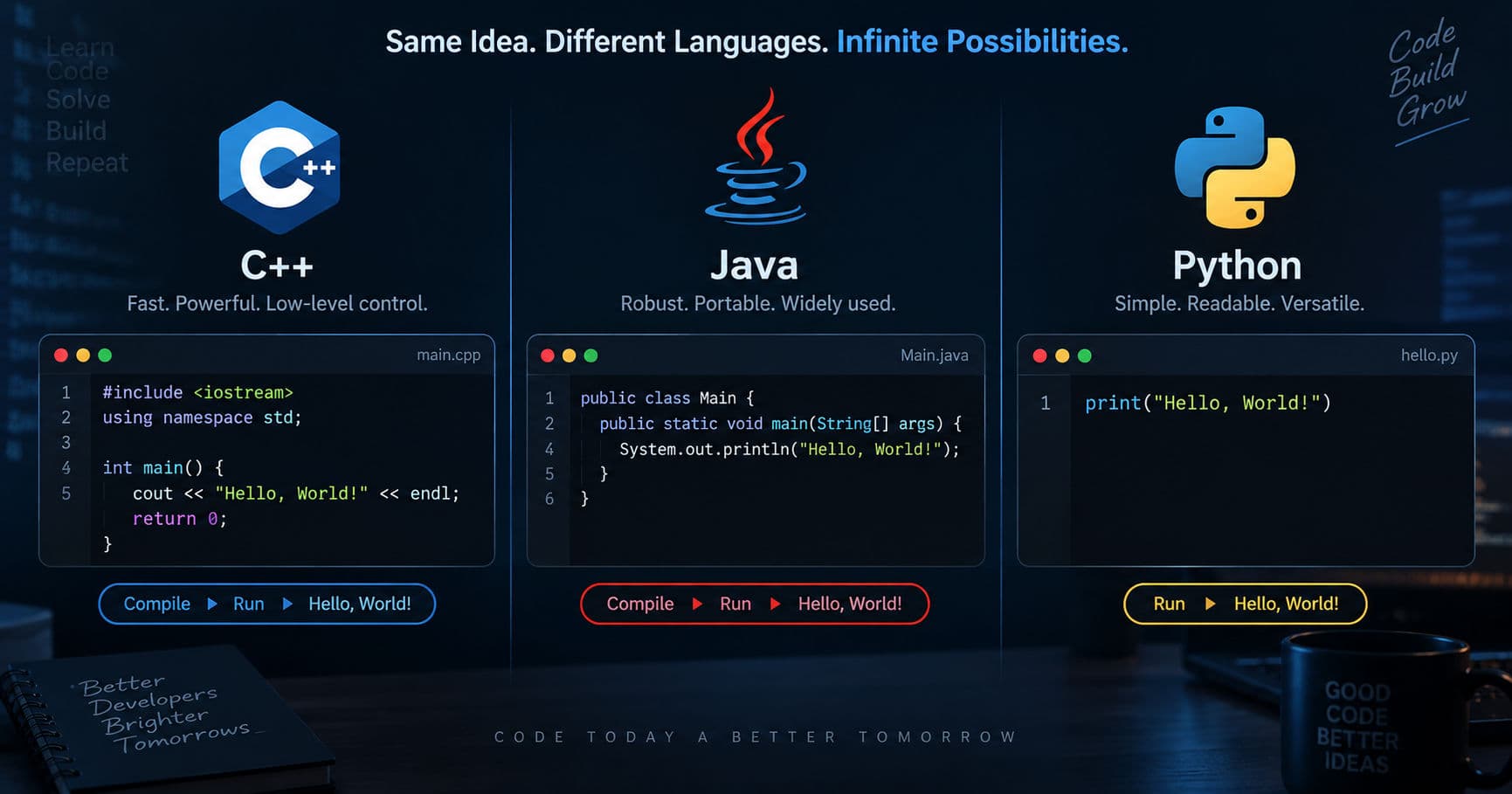
C++ syntax is close to the machine. You manage memory addresses, use pointers, write header files, and handle semicolons and curly braces everywhere. A simple "Hello, World!" program needs an include statement, a main() function, and an explicit return 0;. This gives you fine control but also more room to make mistakes — a missing semicolon or mismatched bracket can break the whole program.
Java Syntax
Java syntax is stricter and more verbose than Python but more structured than C++. Everything lives inside a class, even a simple print statement needs a full class and public static void main(String[] args) declaration. This forces beginners to understand classes and objects from day one, which is good for long-term discipline but can feel like a lot of boilerplate for a two-line program.
Python Syntax
Python syntax reads almost like plain English. There are no semicolons, no curly braces, and indentation itself defines code blocks. Printing "Hello, World!" takes exactly one line: print("Hello, World!"). This is a major reason Python has become the default recommendation for absolute beginners in 2026 — you spend your first weeks learning logic, not fighting syntax errors.
Winner for readability: Python, by a wide margin.
Learning Curve: Which Is Easiest for Beginners?
The learning curve depends on what "learning" means to you.
If your goal is to write your first working program in a weekend, Python wins easily. Its simple syntax, huge beginner community, and instant feedback loop (no compilation step) make it the friendliest entry point.
Java sits in the middle. It teaches you object-oriented thinking early, which is valuable, but the boilerplate code and stricter compiler errors can be discouraging in the first few weeks.
C++ has the steepest learning curve of the three. Concepts like pointers, manual memory allocation, and multiple inheritance are genuinely hard for someone with zero programming background. However, this difficulty pays off later — once you understand C++, picking up other languages feels noticeably easier because you already understand what is happening "under the hood."
A useful way to think about it: Python teaches you to code fast, Java teaches you to code with structure, and C++ teaches you to understand computers.
Performance and Speed
This is where C++ dominates. C++ compiles directly to machine code and gives you manual control over memory and hardware resources, making it the fastest of the three languages. This is exactly why C++ is still the backbone of game engines, operating systems, high-frequency trading systems, and competitive programming judges.
Java runs on the Java Virtual Machine (JVM), which compiles code to bytecode and then uses Just-In-Time (JIT) compilation to optimize performance at runtime. It is slower than C++ but significantly faster than Python, and it scales very well for large enterprise systems that need to run reliably for years.
Python is an interpreted language, which means it translates code line-by-line during execution. This makes it noticeably slower for CPU-heavy tasks. In practice, this rarely matters for beginners or even for most production use cases, because Python's AI and data libraries (like TensorFlow, PyTorch, and NumPy) are written in optimized C or C++ under the hood — you get Python's simplicity with near-native speed for the heavy lifting.
Speed ranking: C++ > Java > Python.
Memory Management
Memory management is one of the most fundamental differences between these languages.
C++ gives you manual memory management. You allocate memory using new and free it using delete. Modern C++ also offers smart pointers (unique_ptr, shared_ptr) to reduce memory leaks, but the responsibility still largely sits with the programmer. This is powerful for performance-critical systems but dangerous for beginners — forgetting to free memory causes leaks, and accessing freed memory causes crashes.
Java uses automatic garbage collection. The JVM periodically identifies objects that are no longer in use and frees their memory without the programmer writing any cleanup code. This removes a huge category of bugs but gives you less control over exactly when memory is freed.
Python also uses automatic garbage collection, combined with reference counting. Like Java, this makes Python much safer for beginners, since you rarely think about memory at all.
Takeaway: If you want to deeply understand how computers manage memory, learn C++. If you want to focus purely on logic and application building, Java or Python will get out of your way.
Object-Oriented Programming Support
All three languages support object-oriented programming (OOP), but the implementation differs.
C++ supports full OOP including multiple inheritance, operator overloading, and both procedural and object-oriented styles in the same program. This flexibility is powerful but can lead to messy code if not disciplined.
Java is built around OOP from the ground up — every piece of code lives inside a class. It supports single inheritance for classes but allows multiple interface implementation, which avoids the classic "diamond problem" that multiple inheritance can cause in C++.
Python supports OOP too, but it is more flexible and less strict. You can write purely functional scripts, purely object-oriented programs, or a mix of both, since Python does not force everything into a class structure.
For learning OOP concepts cleanly: Java is often considered the most structured teacher, though C++ gives you the deepest technical understanding.
Real-World Applications
Understanding where each language is actually used will help you connect learning to career goals.

Competitive Programming
C++ is the dominant language on platforms like Codeforces, CodeChef, and ICPC-style contests. Its speed, extensive Standard Template Library (STL) for data structures like vectors, maps, and priority queues, and fine control over execution time make it the go-to choice for time-constrained problems. Java is used by a smaller but significant portion of competitive programmers, while Python is used less often here due to slower execution, though it works fine for beginner-level practice.
Software Development
All three languages are used in general software development. C++ is common in performance-critical desktop applications and system tools. Java remains a workhorse for large-scale enterprise software, especially in banking, insurance, and government systems, because of its stability, scalability, and backward compatibility. Python is popular for automation scripts, internal tools, and rapid prototyping.
Web Development
Python (with frameworks like Django and Flask) and Java (with Spring Boot) are both heavily used for backend web development. C++ is rarely used directly for web development, though it sometimes powers performance-critical backend components or web servers.
AI and Machine Learning
Python is the undisputed leader here. Every major AI/ML framework — TensorFlow, PyTorch, scikit-learn, Keras, and the Hugging Face ecosystem — is built primarily for Python. If your goal is AI, machine learning, or data science, Python is not just a good choice, it is close to a requirement in 2026.
Game Development
C++ is the industry standard for professional game engines, including Unreal Engine. Its performance and low-level memory control are critical for real-time rendering and physics calculations. Java is used in some game development contexts (Minecraft's original version was built in Java), while Python is popular for smaller indie games and game scripting through tools like Pygame.
Android Development
Java has historically been the primary language for native Android development, and it remains deeply embedded in Android's ecosystem and tooling, though Kotlin has become Google's preferred modern choice. Understanding Java still gives you a strong foundation for Android development because the underlying platform and countless legacy apps are built on it.
Data Science
Python dominates data science thanks to libraries like Pandas, NumPy, and Matplotlib, combined with tools like Jupyter Notebooks that make data exploration fast and visual. Java and C++ are occasionally used for high-performance data pipelines, but Python remains the default teaching and working language for data analysts and scientists.
Cybersecurity
C++ helps in understanding low-level exploits, malware analysis, and reverse engineering, since many vulnerabilities exist at the memory-management level. Python is widely used for security automation scripts and penetration-testing tools due to its simplicity. Java appears in enterprise security tooling and secure backend systems.
Embedded Systems
C++ (along with C) is the primary language for embedded systems, microcontrollers, IoT devices, and firmware, since it allows direct hardware access with minimal overhead. Python is sometimes used for prototyping on devices like Raspberry Pi, but rarely for production firmware.
Cloud Computing
Java is deeply embedded in cloud-native enterprise backends through frameworks like Spring Boot. Python is widely used for cloud automation, scripting, and AI workloads on platforms like AWS, Azure, and Google Cloud. C++ appears more rarely, mostly in performance-critical infrastructure components.
Career Opportunities and Interview Demand in 2026
In 2026, all three languages remain in strong demand, but the type of demand differs.
Python currently leads in overall job postings, driven by the explosion of AI, machine learning, and data roles, with job-tracking platforms showing Python postings significantly outpacing Java in markets like the United States.
Java remains deeply entrenched in enterprise environments. A large majority of Fortune 500 companies still run critical systems on Java, particularly in banking, insurance, and government infrastructure, keeping demand consistent even where growth looks slower than Python's on paper.
C++ demand is more specialized but consistently strong. Roles in game development, embedded systems, high-frequency trading, and core systems programming almost always list C++ as a requirement, and fewer developers are genuinely strong in it, which can work in your favor.
For interviews, especially at India's product and service-based companies, C++ and Java remain extremely common for Data Structures and Algorithms (DSA) rounds, while Python is increasingly accepted and even preferred, particularly at startups and AI-focused firms.
Salary Potential in 2026
Based on 2026 industry salary reports:
- Python developers report strong average salaries, particularly when combined with AI/ML skills, with reported ranges roughly between $98,000 and $188,000 in the U.S. depending on specialization and seniority. Python-with-AI roles tend to see the fastest salary growth.
- Java developers, especially senior architects and enterprise specialists, often command high compensation in banking, fintech, and large-scale enterprise systems, with strong stability even if headline growth looks slower than Python's.
- C++ remains a credible high-paying skill, particularly in game development studios, systems programming, and quantitative finance, where specialized expertise is scarce and highly valued.
These figures vary heavily by country, company size, and experience level. In India, entry-level salaries across all three languages are much closer together, and what matters more for freshers is problem-solving ability and project experience rather than the language on their resume.
Community Support and Ecosystem
Python has arguably the largest and fastest-growing developer community today, driven by its dominance in AI, data science, and beginner education, with an enormous number of tutorials, Stack Overflow answers, and open-source libraries.
Java has one of the most mature communities in software history, with decades of documentation, enterprise frameworks (Spring, Hibernate), and a huge base of legacy codebases that still need maintenance.
C++ has a smaller but highly technical, dedicated community, particularly strong around competitive programming, game development (Unreal Engine forums), and systems programming.
Industry Adoption in 2026
According to trackers like the TIOBE Index, Python continues to hold the top spot in 2026, reflecting its dominance in AI, automation, and scripting. C++ and Java both remain firmly in the top five, showing that despite Python's rise, these "older" languages are far from obsolete — they simply serve different, still-critical parts of the industry: AI-native startups build in Python, enterprises run on Java, and performance-critical industries (gaming, embedded, finance infrastructure) rely on C++.
Pros and Cons of Each Language
C++ Pros and Cons
Pros:
- Extremely fast execution, close to hardware
- Full control over memory and system resources
- Industry standard for game engines and competitive programming
- Strong foundation for understanding how computers actually work
- Valuable, specialized skill with less competition
Cons:
- Steep learning curve for absolute beginners
- Manual memory management increases risk of bugs and crashes
- Verbose and complex syntax
- Slower development speed compared to Python
- Smaller beginner-friendly community compared to Python
Java Pros and Cons
Pros:
- Strong OOP structure, great for learning software design principles
- "Write once, run anywhere" thanks to the JVM
- Extremely stable and widely used in enterprise systems
- Strong job stability, especially in banking and large organizations
- Large, mature ecosystem and documentation
Cons:
- Verbose syntax with a lot of boilerplate code
- Slower than C++ for performance-critical tasks
- Less exciting for beginners chasing quick, visible results
- Considered less "trendy" than Python for new-age AI projects
Python Pros and Cons
Pros:
- Extremely beginner-friendly, simple, readable syntax
- Dominant language for AI, machine learning, and data science
- Huge library ecosystem for almost any task
- Fast to write and prototype with
- Largest and fastest-growing community in 2026
Cons:
- Slower execution speed for CPU-intensive tasks
- Not ideal for competitive programming under tight time limits
- Dynamic typing can lead to runtime errors that static languages catch earlier
- Less commonly used for system-level or embedded programming
Which Language Should You Learn First? (By Learner Type)
There is no universal answer, but here is practical, goal-based guidance.
Engineering Students and College Beginners
If you are just starting your engineering journey and want to build strong fundamentals, start with C++. Most Indian engineering curriculums teach C++ first because it forces you to understand memory, pointers, and data structures deeply — knowledge that transfers well into every other language. If your college teaches Python or Java first, that is fine too; the goal is understanding logic, not memorizing one language forever.
Competitive Programmers
Learn C++. Its speed, STL library, and fine control over execution time make it the practical standard on almost every competitive programming platform. Most top competitive programmers you will study or follow use C++.
AI/ML Enthusiasts
Learn Python. It is effectively non-negotiable for AI and machine learning in 2026, given that nearly every major framework, tutorial, and research paper implementation is built in Python.
Web Developers
Either Python (Django/Flask) or Java (Spring Boot) work well for backend web development, alongside JavaScript for the frontend. If you want faster learning and a gentler curve, start with Python; if you want to target large enterprise backend roles, Java is a strong choice.
Job Seekers Focused on Fast Placement
Consider your target companies. If you're aiming at product-based tech companies and startups, especially AI-focused ones, Python currently has the widest and fastest-growing job market. If you're targeting large enterprises, banks, or government-adjacent IT services companies, Java remains extremely safe and in-demand.
Learning Roadmaps
C++ Roadmap
- Basic syntax, variables, data types, and operators
- Control flow: loops and conditionals
- Functions and recursion
- Arrays, strings, and pointers
- Object-oriented programming: classes, objects, inheritance, polymorphism
- Standard Template Library (STL): vectors, maps, sets, stacks, queues
- Dynamic memory management and smart pointers
- Data Structures and Algorithms (DSA) practice
- Competitive programming or a systems-level project
Java Roadmap
- Basic syntax, variables, and data types
- Control flow and loops
- Methods and arrays
- Object-oriented programming: classes, inheritance, interfaces, polymorphism
- Collections framework (ArrayList, HashMap, etc.)
- Exception handling and file I/O
- Multithreading basics
- A framework like Spring Boot for backend development
- A capstone project: REST API or Android app basics
Python Roadmap
- Basic syntax, variables, and data types
- Control flow, loops, and functions
- Data structures: lists, dictionaries, tuples, sets
- Object-oriented programming basics
- File handling and exception handling
- Libraries: NumPy and Pandas for data handling
- A web framework (Flask or Django) or an ML library (scikit-learn)
- Working with APIs and basic automation scripts
- A capstone project: a data analysis notebook, a web app, or a simple ML model
Free Resources to Learn C++, Java, and Python
- Official documentation: cppreference.com (C++), docs.oracle.com/javase (Java), docs.python.org (Python)
- freeCodeCamp — full beginner courses for all three languages
- GeeksforGeeks — language tutorials plus DSA practice
- W3Schools — quick syntax reference for beginners
- Codeforces, LeetCode, and HackerRank — practice platforms for applying what you learn
- YouTube channels dedicated to each language's fundamentals and projects
- Community-driven platforms like HelloEngineers, where engineering students can follow structured learning paths, ask doubts to peers and mentors, and collaborate on real projects instead of learning in isolation
Project Ideas for Beginners
C++ project ideas:
- A console-based library or inventory management system
- A simple text-based game (tic-tac-toe, snake, or a maze solver)
- A basic data structure visualizer (stack, queue, linked list)
Java project ideas:
- A student management system with file or database storage
- A basic banking application simulating deposits, withdrawals, and transfers
- A simple Android app using Java fundamentals
Python project ideas:
- A web scraper that collects data from a public website
- A basic data analysis project using a public dataset and Pandas
- A simple machine learning model that predicts a value (like house prices) using scikit-learn
- An automation script that organizes files or sends automated emails
Building even one complete project per language teaches you far more than passively watching tutorials.
Common Mistakes to Avoid
- Jumping between languages too quickly. Constantly switching before finishing a beginner course wastes time. Pick one, get comfortable, then branch out.
- Skipping fundamentals for frameworks. Learning Django or Spring Boot before understanding core Python or Java concepts leads to shallow knowledge that breaks down in interviews.
- Ignoring Data Structures and Algorithms. Regardless of language, DSA is what most technical interviews actually test. Language syntax is secondary.
- Copy-pasting code without understanding it. This feels productive short-term but leaves major gaps that show up during debugging or interviews.
- Choosing a language based only on salary reports. Salary data shifts yearly. Choose based on the field you actually want to work in — the income tends to follow genuine skill and interest.
- Not building projects. Tutorials teach syntax; projects teach problem-solving, and employers care far more about what you've built.
FAQs
Q1: Should I learn C++, Java, or Python first as a complete beginner? If you want the gentlest introduction to programming logic, start with Python. If your college curriculum starts with C++ or Java, that is also a perfectly good path — the fundamentals of programming transfer between languages.
Q2: Is C++ still relevant in 2026? Yes. C++ remains essential for game development, competitive programming, embedded systems, and performance-critical software. It consistently ranks in the top three most-used languages worldwide.
Q3: Is Python enough to get a good job in 2026? Python alone, combined with strong problem-solving skills and a portfolio of projects (especially in AI/ML, web development, or automation), is enough to land solid roles, particularly at startups and AI-focused companies.
Q4: Which language is best for competitive programming, C++ or Java? C++ is generally preferred due to its speed and the power of its Standard Template Library, though Java is a completely viable second choice used by many successful competitive programmers.
Q5: Is Java still worth learning with Python's rise in popularity? Yes. Java remains dominant in enterprise software, Android's ecosystem, and large-scale backend systems. It offers strong job stability, especially in banking, insurance, and established tech companies.
Q6: Can I learn all three languages eventually? Absolutely, and many experienced developers do. A common path is starting with one language to build fundamentals, then adding a second for career specialization (like Python for AI or Java for enterprise backend), and picking up C++ later for deeper systems understanding if needed.
Q7: Which language has the best salary in 2026? It depends on specialization more than the language itself. Python roles combined with AI/ML skills currently show some of the fastest salary growth, while senior Java architects and specialized C++ engineers in finance or gaming can also command very high packages.
Q8: Do I need strong math skills to learn any of these languages? Basic logical thinking is enough to start with any of the three. Math becomes more important later if you move into AI/ML (Python), performance optimization (C++), or algorithm-heavy interview preparation (any language).
Final Recommendation
If you genuinely cannot decide, here is a simple way to choose:
- Want the easiest start and a direct path into AI and data science? Learn Python.
- Want strong fundamentals, a path into enterprise software, or Android development? Learn Java.
- Want to master competitive programming, game development, or systems-level understanding? Learn C++.
None of these choices are wrong, and none of them are permanent. Most working developers learn more than one language over their career. What matters most in the first year is not which language you pick, but whether you actually practice consistently, build real projects, and understand the logic behind the code instead of memorizing syntax.
If you're an engineering student figuring this out on your own, you don't have to do it alone. Communities like HelloEngineers exist exactly for this — helping students pick the right learning path, get their doubts answered, find project collaborators, and stay accountable while building real skills instead of just watching tutorials.