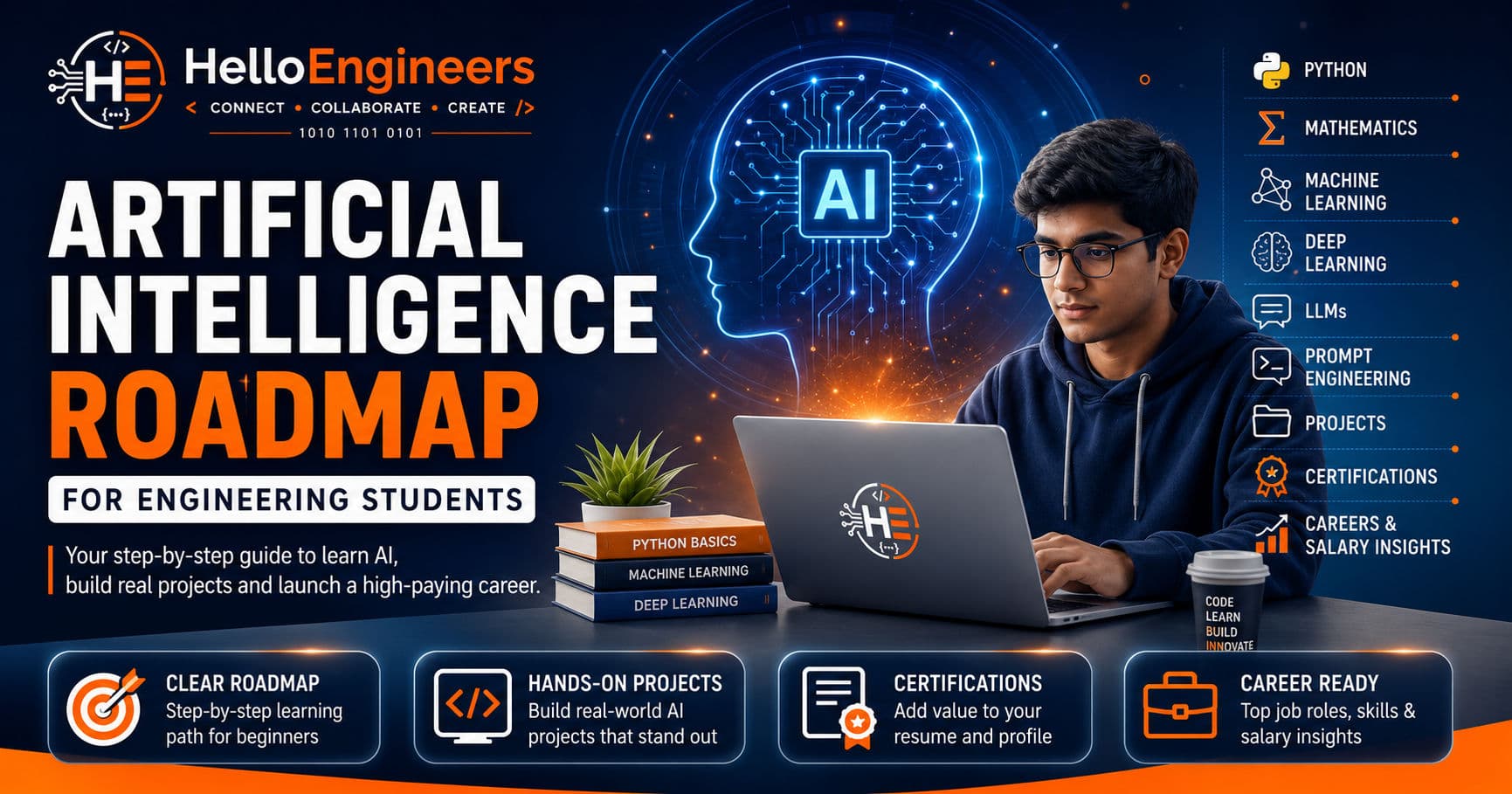
Where Should Engineering Students Start with AI?
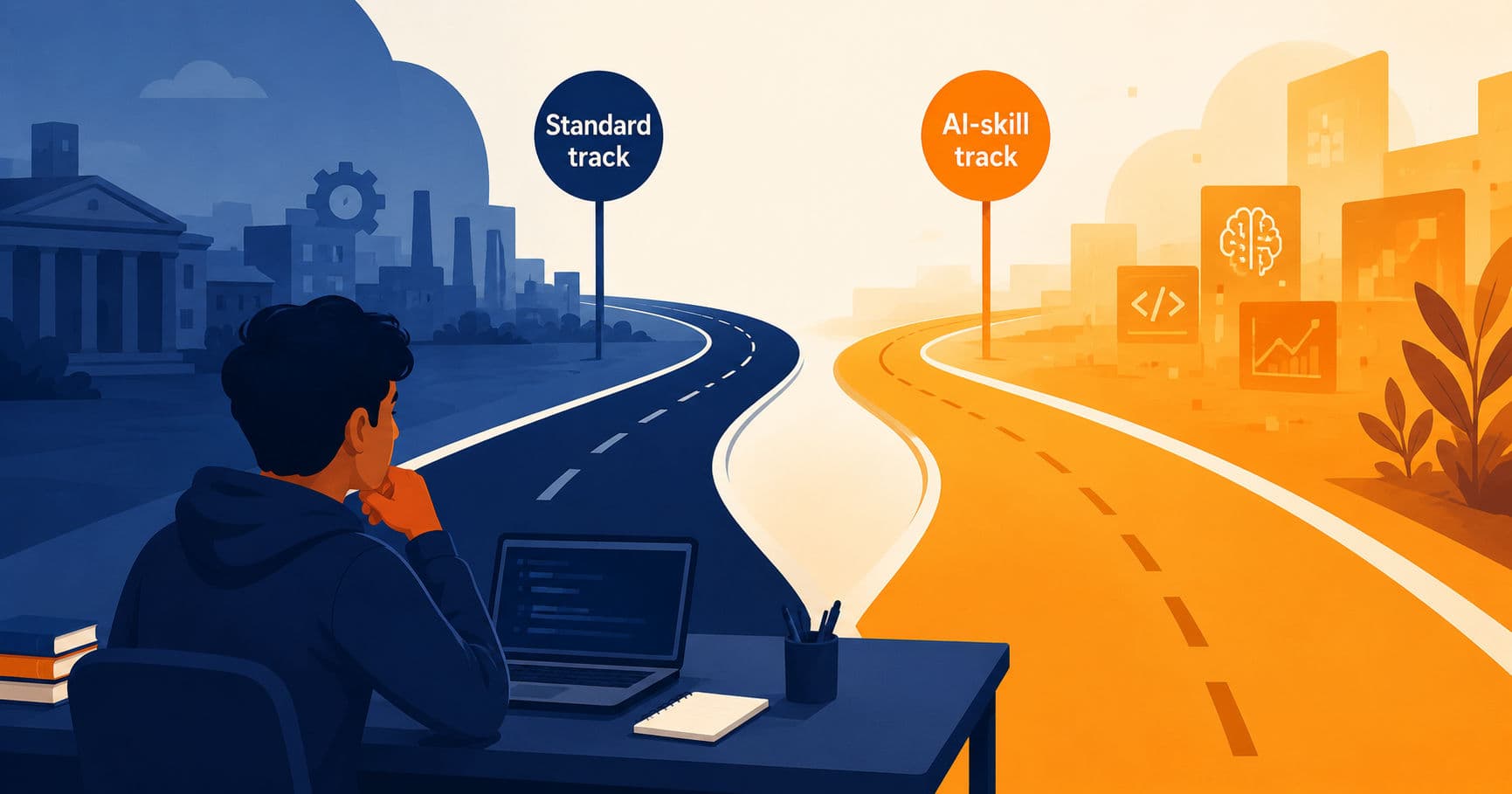
If you're an engineering student right now, chances are someone has already told you to "learn AI" without explaining what that actually means. It's a fair bit of advice, but a confusing one too, because artificial intelligence isn't one subject you can finish in a weekend. It's a stack of skills that build on each other, and jumping in without a plan is how a lot of students end up watching YouTube tutorials for months without building anything real.
Why Engineering Students Need an AI Roadmap
Almost every engineering branch is touching AI in some form now — mechanical students are using it for predictive maintenance, civil engineers for structural analysis, and electronics students for embedded intelligence in devices. So this isn't just advice for computer science majors anymore.
The problem is that most students either go too fast, jumping straight into deep learning without understanding the math underneath it, or they get stuck in tutorial loops and never build anything of their own. A structured AI roadmap for engineering students helps avoid both traps by giving you a clear order to learn things in, along with realistic milestones.
Step 1: Get Comfortable With AI Fundamentals:
Before touching any code, it helps to understand what AI actually is, and just as importantly, what it isn't. Artificial intelligence is a broad field concerned with making machines perform tasks that normally require human intelligence — recognizing images, understanding language, making decisions. Machine learning is a subset of that, and deep learning is a subset of machine learning. Knowing this hierarchy will save you a lot of confusion later when terms start overlapping in job postings and course names.
At this stage, focus on reading rather than coding. Understand concepts like supervised and unsupervised learning, what a dataset is, and why models need training data in the first place. A few good YouTube channels or a short online course can cover this in a couple of weeks. There's no need to rush this part; a shaky foundation here tends to cause problems much later.
Step 2: Learn Python Properly:
Python is the language of choice for almost all AI work, and for good reason — it's readable, has a massive ecosystem of libraries, and most AI research papers publish code in it. If you already know another programming language from your engineering coursework, picking up Python syntax won't take long.
What matters more than syntax is getting comfortable with libraries like NumPy for numerical computation, Pandas for handling data, and Matplotlib for visualizing it. Spend real time here. A lot of students rush through Python basics and then struggle later because they can't manipulate a dataset without looking up every single function. Try to reach a point where writing a small data-cleaning script feels natural rather than a search-engine exercise.
Step 3: Build a Solid Math Foundation:
This is the part most students want to skip, and it's usually a mistake. You don't need to become a mathematician, but three areas come up constantly in AI work: linear algebra, calculus, and probability with statistics.
Linear algebra helps you understand how data is represented and transformed inside models — vectors, matrices, and operations on them. Calculus, specifically derivatives, explains how models learn through a process called gradient descent. Probability and statistics help you understand uncertainty, distributions, and how to evaluate whether a model is actually performing well or just got lucky on a small test set.
You don't need to master these before moving on. A working understanding is enough to start, and the concepts will make more sense once you see them applied in actual ML algorithms.
Step 4: Machine Learning Basics:
This is usually where things start feeling exciting because you begin building models that predict things. Start with classical algorithms — linear regression, logistic regression, decision trees, and k-nearest neighbors. These are simpler to understand than deep learning models and give you intuition for how learning from data actually works.

Scikit-learn is the go-to library here, and it's forgiving enough for beginners while still being used in real industry projects. Practice on public datasets from Kaggle or UCI's repository. Try predicting house prices, classifying emails as spam, or something similarly small in scope. The goal isn't to build something impressive yet — it's to understand the full workflow: cleaning data, splitting it into training and test sets, training a model, and evaluating results.
Step 5: Move Into Deep Learning:
Once classical machine learning feels manageable, deep learning is the natural next step. This is where neural networks come in — models loosely inspired by how neurons connect and pass signals. Deep learning is what powers image recognition, speech systems, and, eventually, the large language models we'll get to next.
Learn the basics of neural network architecture, then move to convolutional neural networks (CNNs) for image-related tasks and recurrent neural networks (RNNs) for sequence data like text or time series. TensorFlow and PyTorch are the two major frameworks here; PyTorch tends to be more popular in research and among students because of its readable, Python-like syntax.
Don't worry about understanding every mathematical detail behind backpropagation on your first pass. Build a few small projects, come back to the theory later, and it'll click more easily the second time around.
Step 6: Understand Large Language Models (LLMs):
LLMs are arguably the reason AI became a household topic over the last couple of years. Models like GPT, Claude, and Gemini fall into this category, and understanding how they work — even at a conceptual level — has become almost as important as knowing traditional ML now.
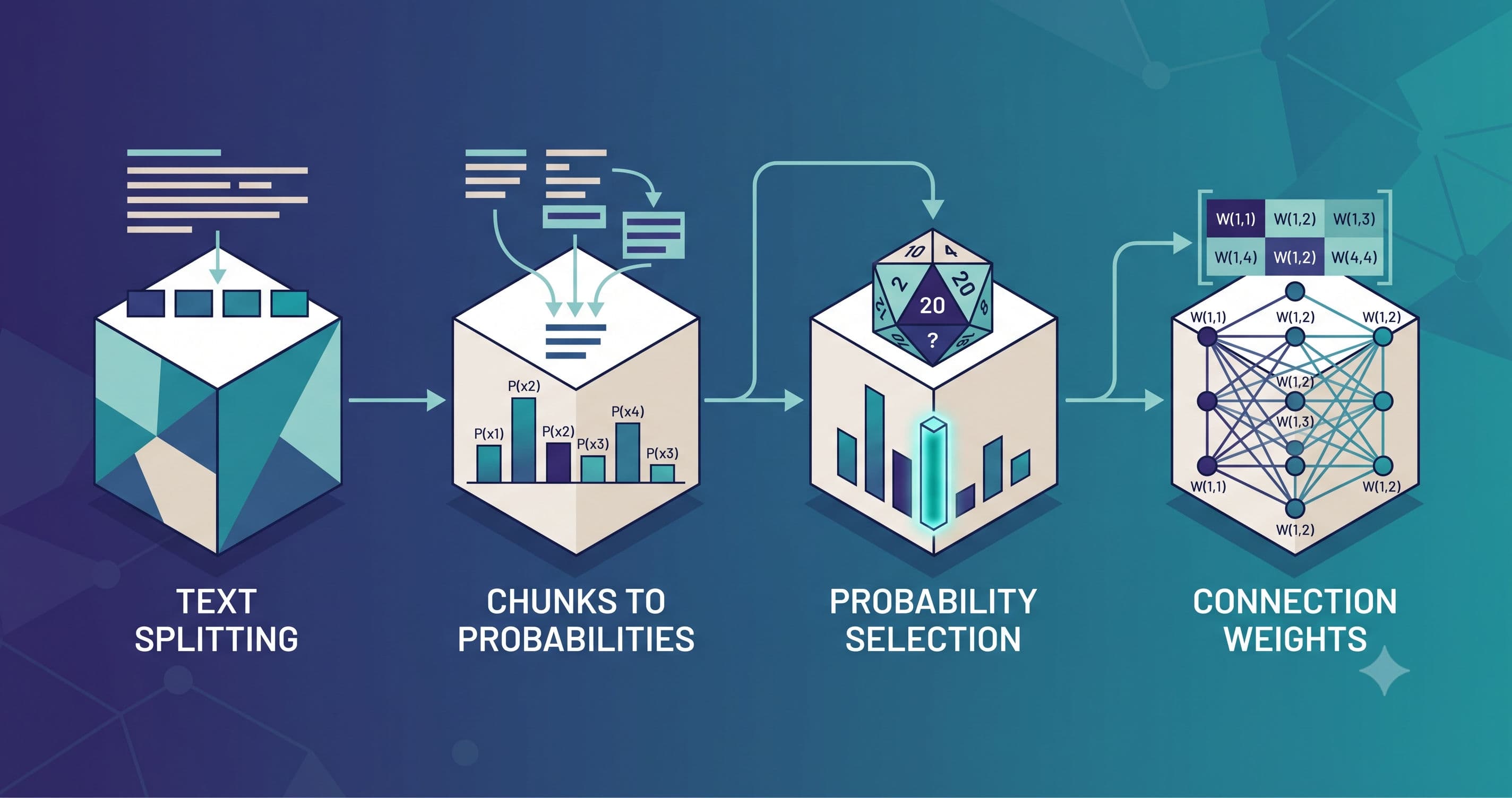
You don't need to train an LLM from scratch; that requires resources far beyond what a student typically has access to. Instead, focus on understanding transformer architecture at a high level, what tokens and embeddings are, and how fine-tuning and retrieval-augmented generation (RAG) work. Try building small applications using APIs from OpenAI, Anthropic, or open-source models like Llama, so the theory connects to something practical you can actually run and test.
Step 7: Learn Prompt Engineering:
Prompt engineering sounds simple on paper — just write good instructions for an AI model — but it's become a genuine skill with its own techniques. Learning how to structure prompts, use examples effectively, and break complex tasks into smaller steps can dramatically change the quality of output you get from an LLM.
This skill matters even if you're not planning a career purely in AI, because more roles across engineering now expect some comfort working with AI tools day to day. Spend some time experimenting with techniques like few-shot prompting, chain-of-thought prompting, and role-based instructions. It's a low-cost, high-return part of any AI roadmap for engineering students, since it takes relatively little time to learn but shows up in almost every AI-adjacent job now.
Step 8: Build Real Projects:
Projects are where everything you've learned actually gets tested. Employers and recruiters look at projects far more closely than they look at course completion certificates, so this step deserves serious attention.
A few project ideas that work well for a portfolio:
- A spam or sentiment classifier using classical ML
- An image classification tool using a CNN
- A chatbot built with an LLM API, ideally with some domain focus like a study assistant or a customer support bot
- A recommendation system for movies, books, or products
- A small RAG-based application that answers questions from a custom document set
Aim for two or three solid projects rather than ten half-finished ones. Document your process on GitHub, write a short explanation of what problem you solved and why you made certain choices, and if possible, deploy at least one project so it's actually usable rather than just code sitting in a repository.
Step 9: Certifications Worth Considering:
Certifications won't replace projects, but they do add credibility, especially early in your career when you don't have much work experience to show. A few that are genuinely respected in the industry include Google's Machine Learning and AI certifications, AWS Certified Machine Learning, Microsoft's Azure AI Engineer certification, and DeepLearning.AI's courses on Coursera, particularly the ones taught by Andrew Ng.
Pick one or two that align with the direction you want to go, rather than collecting certificates for the sake of it. A certification alongside a couple of strong projects tends to carry more weight than a stack of certificates with nothing built to back them up.
Career Opportunities and Salary Insights
Once you've worked through this path, several career directions open up, and the pay tends to reflect the demand:
- Machine Learning Engineer — average salaries in India range roughly from ₹6-15 LPA for freshers with strong projects, going well above ₹25 LPA with a few years of experience. In the US, entry-level roles often start around $95,000-$120,000 annually.
- Data Scientist — similar range, often slightly higher once you factor in specialized domain knowledge like finance or healthcare.
- AI/Prompt Engineer — a newer role but growing fast, with salaries often comparable to ML engineering roles, sometimes higher at companies building LLM-based products.
- Computer Vision Engineer — in demand across automotive, manufacturing, and healthcare imaging, with pay generally on par with ML engineering.
- NLP Engineer — focused specifically on language-related AI, increasingly overlapping with LLM application development.
These numbers shift depending on location, company size, and how strong your portfolio is, but the overall trend is clear: demand for people who can actually build and deploy AI systems, not just talk about them, keeps growing across almost every engineering discipline.
Final Thoughts
There's no shortcut through this roadmap, and honestly, that's probably a good thing. Skipping steps tends to catch up with you later, usually right around the time you're trying to explain a project in an interview and realize you don't fully understand how it works. Take this AI roadmap for engineering students as a general order to follow, adjust the pace to what fits your schedule, and prioritize building things over just consuming content. That combination — steady learning plus real projects — is what actually gets noticed when you start applying for roles.
Frequently Asked Questions
1. Is Python necessary for learning AI?
Yes. Python is the most widely used language for Artificial Intelligence because of its extensive libraries, readability, and community support.
2. Can first-year engineering students start learning AI?
Absolutely. First-year students can begin with Python and basic mathematics before gradually progressing to machine learning and deep learning.
3. Is mathematics compulsory for Artificial Intelligence?
A basic understanding of linear algebra, probability, statistics, and calculus is highly recommended to understand how AI models work.
4. Which projects are best for AI beginners?
Projects like spam detection, house price prediction, sentiment analysis, recommendation systems, and chatbots are excellent starting points.
5. What is the average salary of an AI Engineer in India?
Entry-level AI Engineers typically earn around ₹8–18 LPA, though salaries vary based on skills, internships, projects, company, and location.
6. Are AI certifications enough to get a job?
No. Certifications can add value, but employers generally place greater emphasis on practical projects, problem-solving ability, internships, and a strong GitHub portfolio.