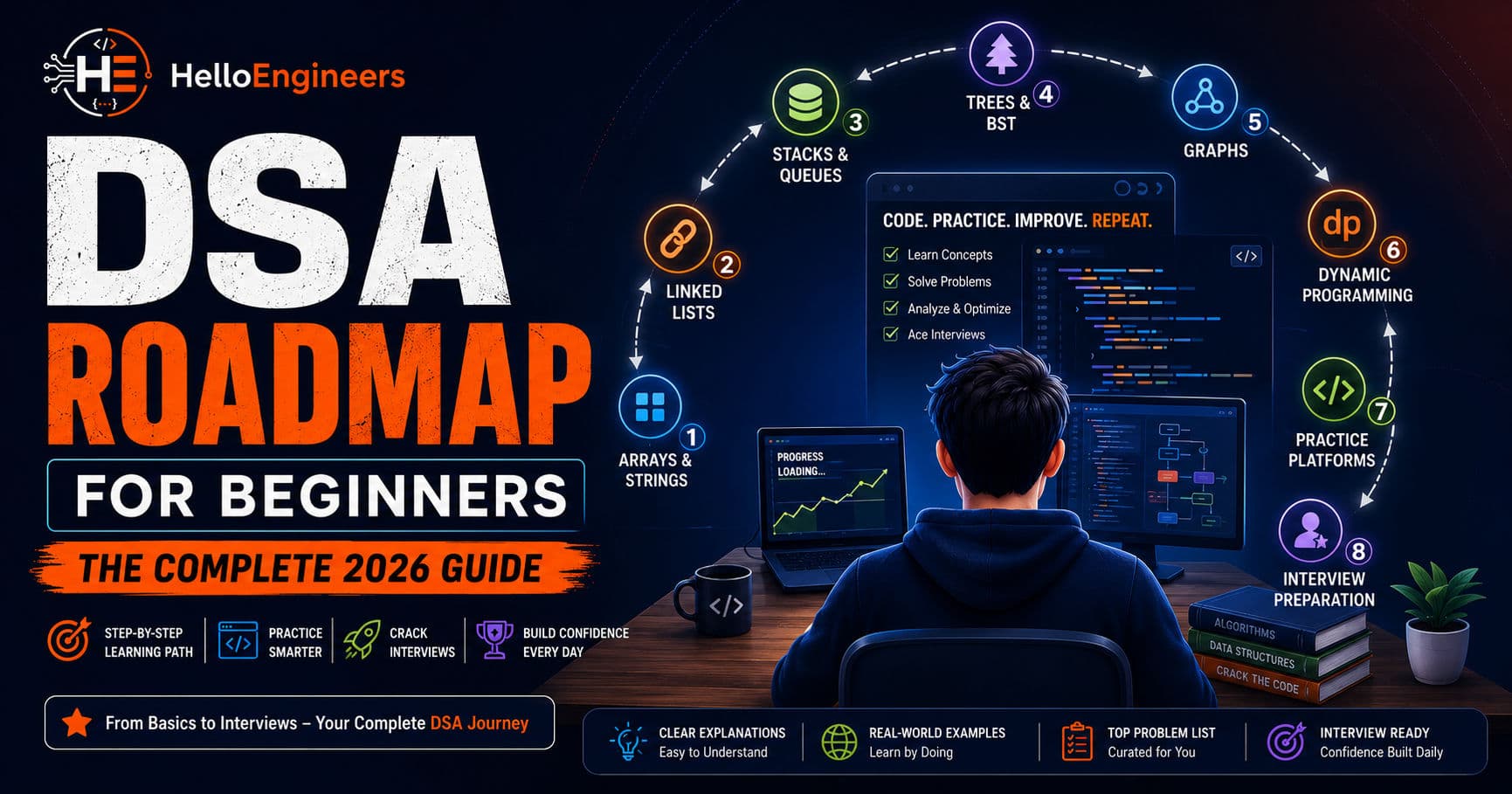
DSA Roadmap for Beginners: The Complete 2026 Guide
If you have ever opened LeetCode, stared at a problem for ten minutes, and closed the tab feeling defeated, you are not alone. Almost every developer goes through that phase. The good news is that a proper DSA roadmap for beginners can turn that confusion into a clear, manageable path. You don't need to be a genius or a computer science topper to get good at this. You just need the right order, consistent practice, and patience with yourself.
This guide walks through exactly what to learn, in what order, and how to avoid the mistakes that slow most beginners down.
Why You Need a Structured Roadmap
Jumping randomly between YouTube videos and random problems is probably the biggest reason people quit DSA. A structured DSA roadmap for beginners works because it builds concepts on top of each other. You can't understand trees properly if recursion still feels shaky, and graphs make a lot more sense once trees click. So instead of chasing "trending" topics, follow a sequence that actually builds on itself.
Step 1: Programming Fundamentals
Before touching data structures, get comfortable with a language, ideally C++, Java, or Python. You should be able to write loops, functions, and basic conditionals without googling syntax every five minutes. This part isn't glamorous, but skipping it makes everything after feel harder than it needs to be.
Step 2: Arrays and Strings
Arrays are where almost every roadmap starts, and for good reason. Once you understand indexing, traversal, and basic operations, move into common patterns like two pointers, sliding window, and prefix sums. Strings follow naturally after arrays since they behave similarly in most languages. Spend real time here; a huge chunk of interview questions are just arrays and strings in disguise.
Step 3: Linked Lists
This is usually the first place beginners feel a mental shift, since linked lists don't work with simple indexing. Practice reversing a list, detecting cycles, and merging two sorted lists. Draw the pointers on paper if you have to. Visualizing them genuinely helps more than reading code silently.

Step 4: Stacks, Queues, and Recursion
Learn stacks and queues alongside recursion, since they naturally reinforce each other. Recursion trips up a lot of people early on, so don't rush it. Problems like balanced parentheses, next greater element, and basic backtracking are great starting points.
Step 5: Trees and Binary Search Trees
Trees are where a solid DSA roadmap for beginners really starts paying off. Learn traversals (inorder, preorder, postorder), height, diameter, and BST operations. Once trees feel comfortable, binary search trees and balanced trees will feel like a natural extension rather than something new entirely.
Step 6: Graphs
Graphs scare a lot of beginners, but they don't need to. Start with BFS and DFS, then move into topological sorting, shortest paths, and union-find. Most real-world problems, from maps to social networks, are graphs underneath, so this section is worth the extra effort.
Step 7: Dynamic Programming
Dynamic programming is usually the final boss for beginners, and honestly, it deserves that reputation a little. Start with simple problems like Fibonacci and climbing stairs before moving to knapsack-style questions. The trick is recognizing overlapping subproblems, not memorizing patterns. Give this stage extra time; rushing it rarely works out well.
Best Platforms to Practice
- LeetCode – best for interview-style problems and company tags
- GeeksforGeeks – great explanations alongside practice questions
- Codeforces – useful once you want to sharpen competitive programming skills
- NeetCode – excellent curated lists for structured practice
A Simple Daily Study Plan
You don't need eight-hour marathons. A realistic plan looks like this:
- 30 minutes reviewing a concept or watching a short explanation
- 1 to 1.5 hours solving 2 to 3 problems
- 15 minutes revisiting a problem you struggled with earlier in the week
Consistency beats intensity here. Solving problems daily for three months will get you further than solving fifty problems in one exhausting weekend.
Common Mistakes Beginners Make
Many people jump straight into hard problems without mastering the basics, which usually backfires. Others memorize solutions instead of understanding the logic behind them, so the knowledge doesn't transfer to new problems. Skipping revision is another common trap; concepts fade quickly without repetition. Lastly, comparing your pace to someone else's timeline online rarely helps and often just adds unnecessary stress.
Interview Preparation Tips
Once you're comfortable across topics, start timing yourself. Practice explaining your thought process out loud, since interviewers care about reasoning as much as the final answer. Revisit weak areas regularly instead of only solving new problems, and try mock interviews closer to your actual interview dates to build confidence under pressure.
Final Thoughts
A good DSA roadmap for beginners isn't about rushing through topics as fast as possible. It's about building understanding step by step, so each new concept feels like a natural continuation rather than a fresh struggle. Stick with the order, practice regularly, and give yourself credit for the small wins along the way. By the time you reach dynamic programming and graphs, you'll realize just how far that consistent, unglamorous daily practice has actually taken you.
Frequently Asked Questions
1. How long does it take to learn DSA from scratch?
With regular practice of 1–2 hours daily, most beginners can build a solid foundation in about 4–6 months.
2. Which language is best for learning DSA?
C++, Java, and Python are all excellent choices. Pick one language and stick with it throughout your learning journey.
3. Is DSA necessary for web development?
While you can build websites without advanced DSA, strong DSA skills significantly improve problem-solving and are essential for many technical interviews.
4. Which platform is best for DSA practice?
LeetCode is widely used for interview preparation, while GeeksforGeeks, HackerRank, and CodeStudio are also great for beginners.
5. Should I learn algorithms before data structures?
It's better to learn them together. Most algorithms are built around specific data structures, so studying them side by side provides better understanding.