What counts as new EV technology in 2026?
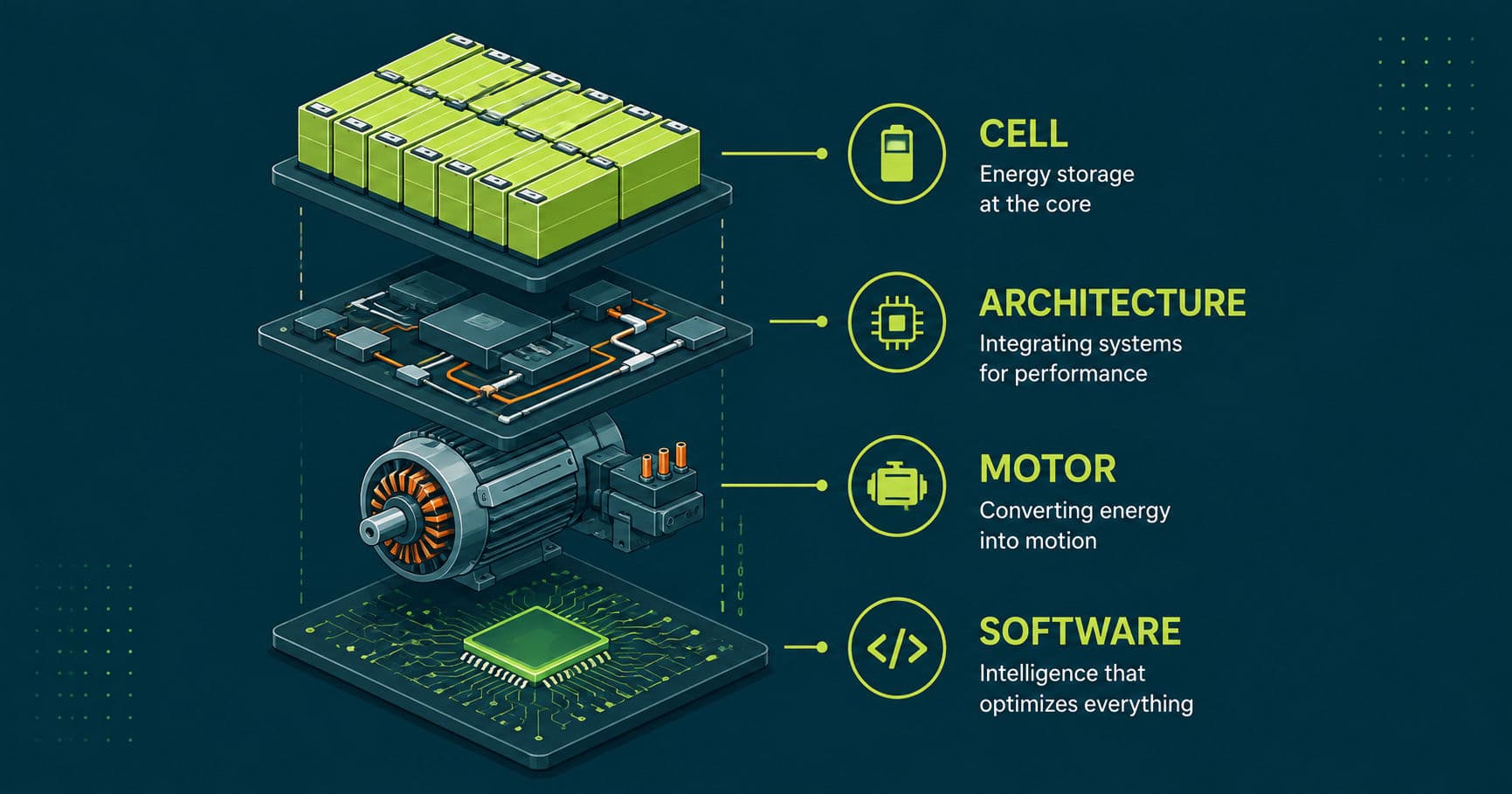
New EV technology in 2026 sits in four layers: the cell chemistry, the electrical architecture around it, the motor, and the software controlling all three.
That framing matters because most articles mix them together. A battery chemistry breakthrough, a jump from 400V to 800V, and an over-the-air software update are three completely different kinds of change with different timelines and different engineering skills behind them.
One rule to carry through everything below: a cell is not a pack, and a lab claim is not a product. When a company announces 500 Wh/kg, that figure is almost always cell-level. By the time the cell is packaged with cooling, structure, wiring and a battery management system, the pack-level number is meaningfully lower. Range figures quoted under China's CLTC test cycle are also optimistic relative to what a driver sees on a highway.
Read every claim in this article, and every claim you meet elsewhere, against those two distinctions.
Are solid-state batteries actually available?
Not in the true sense. Vehicles sold in 2026 as having solid-state batteries use semi-solid or hybrid solid-liquid cells, where some liquid electrolyte remains. All-solid-state batteries are still in pilot production.
The distinction is not pedantic — it is what the entire industry timeline turns on. A solid-state battery replaces the liquid electrolyte with a solid one, which promises higher energy density and lower fire risk. A semi-solid cell moves partway there, keeping a small amount of liquid, and can be produced on modified versions of existing lithium-ion lines rather than new ones.
Where things actually stand, by the companies' own statements:
- Semi-solid is in production. SAIC launched the MG4 as what it described as the first mass-produced semi-solid-state EV, and NIO sells a 150 kWh pack using WeLion semi-solid cells reported at roughly 350–360 Wh/kg.
- All-solid-state is at pilot scale. BYD, SAIC, Dongfeng and FAW have signalled small-volume production from 2027, with wider production generally targeted around 2030. GAC completed an all-solid-state production line and aims to ramp between 2027 and 2030. Toyota, which holds the largest solid-state patent portfolio, targets mass production in the 2027–2028 window.
- Standards are still being written. China's National Automotive Standardization Technical Committee circulated a draft standard defining solid-state battery terminology in December 2025, with a final release expected in 2026. The fact that the industry needed a standard to define what the words mean tells you how loosely they have been used.
Treat headline numbers carefully. FAW reported a lithium-rich manganese semi-solid cell exceeding 500 Wh/kg in a 142 kWh pack claiming over 1,000 km of CLTC range. That is a manufacturer claim, at cell level, on an optimistic test cycle, in a prototype. It may well be real. It is not the same as a product specification.
Honest limitation: solid-state solves some problems and creates others. The hardest is the solid-to-solid interface between electrode and electrolyte, where contact degrades over cycles. Manufacturing cost is the second. This is why the timelines keep sliding right.
Why sodium-ion and LFP matter more in India
Sodium-ion and LFP chemistries matter disproportionately in India because they reduce dependence on materials India does not have and does not control.
LFP (lithium iron phosphate) drops nickel and cobalt from the cathode. It has lower energy density than nickel-based chemistries but better thermal stability, longer cycle life and lower cost — a trade that suits two-wheelers, three-wheelers and buses far better than it suits a long-range luxury sedan. Which is precisely the Indian market.
Sodium-ion goes further and replaces lithium itself. Sodium is abundant and geographically spread. The trade-off is real: sodium-ion cells carry less energy per kilogram, so they suit stationary storage and small vehicles rather than long-range cars.
Research from the Council on Energy, Environment and Water (CEEW) in 2026 frames the strategic case directly: India's battery demand for EVs and grid storage is projected to reach roughly 1.3 TWh by 2047, and building that on lithium-ion alone concentrates risk in supply chains India does not own. Diversifying chemistry is a supply-chain decision as much as a technical one.
For a student, that reframes what "advanced" means. Working on sodium-ion cell characterisation or LFP pack thermal management is not a lesser topic than solid-state — it is closer to what Indian manufacturers will actually need engineers for in the next five years.
What are 800V architectures and silicon carbide?
An 800V architecture roughly doubles the pack voltage from the traditional 400V standard, and silicon carbide power devices are what make it practical.
The physics is simple. Power equals voltage times current. Double the voltage and you halve the current for the same power, which means thinner and lighter copper, less resistive heating, and the ability to push far more power during DC fast charging without melting anything.
The catch is the inverter, which converts the pack's DC into the AC the motor needs. Traditional silicon IGBTs lose efficiency and generate heat at these voltages. Silicon carbide MOSFETs, a wide-bandgap semiconductor, switch faster and tolerate higher temperatures, which raises inverter efficiency and shrinks the cooling system around it. Industry analyses through 2026 also point to a manufacturing shift from 150mm to 200mm SiC wafers, which is what will eventually pull the cost down to mid-range vehicles.
Two honest caveats. First, 800V is not automatically better for the buyer: it only pays off when there is charging infrastructure capable of delivering that power, which in most Indian cities there is not yet. Second, SiC is more expensive than silicon and its supply is concentrated in a small number of fabs, so the cost benefit arrives with a supply risk attached.
For Indian two-wheelers, none of this applies directly — a scooter runs at far lower voltages. The relevant skill transfer is in power electronics generally: inverter design, switching losses, and thermal management, which matter at every voltage.
What is changing in EV motors?
The motor itself is being redesigned to use fewer rare-earth magnets and to pack more power into less space.

Permanent magnet synchronous motors (PMSM) dominate, holding roughly 80–85% of the market according to Benchmark Minerals' 2026 analysis, because they are efficient and power-dense. Their weakness is the rotor magnets, which use rare-earth elements such as neodymium and samarium — materials with concentrated, politically exposed supply chains.
Two responses are visible in 2026:
- Rare-earth-free designs. Motor specialist YASA announced development of fully rare-earth-free and heavy-rare-earth-free axial flux motor technologies for future electric and hybrid vehicles.
- Axial flux geometry. In a conventional radial flux motor, magnetic flux runs outward from the shaft. In an axial flux motor it runs parallel to the shaft, which allows a much flatter, more power-dense package. Reported 2026 results include a Chinese research design at 25.73 kW/kg at 18,000 rpm, and Xiaomi's HyperEngine V8S EVO, claimed at 28,000 rpm and 98.38% efficiency using 0.15 mm silicon steel laminations and an in-house SiC module.
Those efficiency and power-density figures are manufacturer and research claims rather than independently verified specifications, so read them as direction of travel rather than settled fact.
Limitation worth naming: axial flux motors are harder and costlier to manufacture, and rare-earth-free designs generally give up some power density. Neither is a free win.
How is charging technology changing?
Charging is splitting into four distinct approaches, and India's answer is different from the West's.
- DC fast charging is getting faster, enabled by the 800V architectures above.
- Battery swapping replaces charging time with an exchange. This is India's most significant EV innovation, and it is a business-model change as much as a technical one: in most Indian swap networks the network owns the packs and the rider subscribes to a pool. Since the battery is roughly 30–40% of an electric scooter's cost, removing it from the sticker price and converting it into a monthly expense changes the purchase decision entirely. There is an elegant engineering consequence too — swap stations typically charge packs slowly in temperature-monitored cabinets, so the rider gets fast-charging convenience while the cell gets the gentler slow charge that extends its life.
- Wireless charging exists in pilots rather than products, both static (charging while parked) and dynamic (charging while moving over an instrumented road), with trials running in the US, Europe and Japan.
- Vehicle-to-grid (V2G) turns a parked fleet into grid storage, discharging back during peak demand.
The Indian policy position is worth knowing: NITI Aayog released a draft battery swapping policy in April 2022, but a final national policy has not been notified. Meanwhile the PM E-DRIVE scheme's charging allocation subsidises swap-station infrastructure. Swap batteries must still meet AIS-156 safety norms like any other pack.
Software-defined vehicles and smarter battery management
The software-defined vehicle (SDV) treats the car as a computing platform whose functions are delivered and updated in software rather than fixed at manufacture.
In practice this means a centralised computing architecture instead of dozens of independent electronic control units, over-the-air updates that change vehicle behaviour after purchase, and features sold as subscriptions. CES 2026 coverage placed AI-native vehicle systems, SDV architectures and vehicle-to-everything communication at the centre of what manufacturers chose to show.
The layer most relevant to engineering students is the battery management system. A BMS estimates state of charge and state of health — neither of which can be measured directly, only inferred from voltage, current and temperature. Machine-learning approaches to that estimation are an active research area, and industry analyses through 2026 point to ML-driven BMS and ML-optimised charging as near-term directions.
This is the most accessible entry point in the whole article. A BMS estimation project needs a laptop, Python and a public dataset. It needs no lab, no vehicle and no budget.
Hype versus shipping: a maturity table
The single most useful thing to know about any EV technology is which stage it is actually at.
| Technology | Status in 2026 | Realistic mainstream |
|---|---|---|
| Semi-solid-state cells | In production, limited models | Now, premium segment |
| All-solid-state cells | Pilot lines, prototypes | ~2030 per maker roadmaps |
| LFP packs | Mainstream | Now |
| Sodium-ion | Early commercial, mostly storage | Late this decade |
| 800V + SiC | Shipping, moving to mid-range | Now in premium, spreading |
| Axial flux motors | Niche production, research push | Late this decade |
| Battery swapping (India) | Operating networks | Now, two/three-wheelers |
| Wireless charging | Pilots only | Not established |
The pattern across the table: chemistry moves slowly and architecture moves quickly. If you are choosing where to invest study time, the architecture and software layers pay off sooner.
Six EV Projects You Can Build With Free Data
Each project below is scoped for a semester, uses public data or affordable hardware, and maps to one of the technologies above. None of these include tested code — they are specifications, and you should expect to debug your own implementation.
1. State-of-charge estimation from public battery data
Build: Estimate a cell's state of charge from voltage, current and temperature, comparing a Kalman filter against a small neural network. Data: NASA's Prognostics Data Repository battery datasets and the Oxford Battery Degradation Dataset are both publicly available. Proves: Applied estimation theory and the core problem of every BMS. Stack: Python, NumPy, scikit-learn or PyTorch.
2. Battery degradation and state-of-health prediction
Build: Predict remaining useful life from early-cycle data, and report where your model fails rather than only where it works. Data: The same public cycling datasets, split by cell. Proves: Time-series modelling plus honest evaluation, which is rarer in student projects than the model itself.
3. Battery-swap network placement optimiser
Build: Given a city's road network and demand assumptions, place N swap stations to minimise rider detour distance. Data: OpenStreetMap road data through OSMnx; state your demand assumptions explicitly since real swap-demand data is not public. Proves: Optimisation and geospatial analysis, applied to a genuinely Indian problem.
4. Field-oriented control of a BLDC motor
Build: Implement field-oriented control on a low-cost BLDC motor and driver, logging current and speed under varying load. Hardware: A hobby BLDC motor, a driver board and any microcontroller with sufficient PWM channels. Proves: Real power electronics and control, and the difference between simulation and a motor that overheats.
5. Vehicle-to-grid scheduling simulator
Build: Simulate a fleet of EVs charging and discharging against a time-of-day tariff, and quantify what V2G saves and what it costs in extra cycles. Data: Published state discom tariff schedules; model degradation cost with a stated, cited assumption. Proves: Systems modelling and economic reasoning, which most technical projects skip.
6. Range predictor for Indian riding conditions
Build: Predict remaining range for a two-wheeler from speed profile, load, gradient and ambient temperature. Data: Log your own rides with a phone GPS app; combine with elevation data from a public API. Proves: Data collection discipline and physics-based modelling, and it is one of the few projects here where you generate original data.
Scope honestly. One of these done properly, with a documented evaluation and an admitted failure mode, is worth more in an interview than three half-finished ones. And if you use a public dataset, cite it — examiners check.
Common Mistakes
| Mistake | Why it happens | Fix |
|---|---|---|
| Quoting cell energy density as pack figures | Press releases rarely specify which | State the level explicitly; pack figures are lower |
| Treating CLTC or NEDC range as real-world | The number is in every headline | Note the test cycle beside any range figure |
| Calling semi-solid cells "solid-state" | Marketing uses the terms loosely | Say semi-solid where that is what it is |
| Picking a solid-state project topic with no lab | It sounds most advanced | Choose a modelling or BMS topic you can actually complete |
| Ignoring Indian chemistry priorities | Global coverage is car-centric | LFP, sodium-ion and swapping match India's two-wheeler market |
| Using manufacturer claims as verified specs | They are stated confidently | Attribute the claim to the company and the year |
| Building a project with no evaluation | The model working feels like the finish line | Add a test set and report failures |
Frequently Asked Questions
Are solid-state batteries available in electric vehicles in 2026?
Not in the full sense. EVs marketed as solid-state in 2026 use semi-solid or hybrid solid-liquid cells that retain some liquid electrolyte. All-solid-state batteries remain at pilot scale, with several Chinese and Japanese manufacturers targeting small-volume production from 2027 and wider production around 2030.
What is the difference between semi-solid and all-solid-state batteries?
A semi-solid cell replaces part of the liquid electrolyte with solid material while retaining some liquid, and can be manufactured on modified existing lithium-ion lines. An all-solid-state cell removes liquid electrolyte entirely, promising higher energy density and better safety, but faces unsolved problems at the solid-to-solid interface and much higher manufacturing cost.
Why is sodium-ion battery technology important for India?
Sodium-ion replaces lithium with sodium, which is abundant and geographically distributed, reducing dependence on lithium supply chains India does not control. The trade-off is lower energy density, which suits stationary storage, two-wheelers and three-wheelers more than long-range cars — close to where India's EV market actually is.
What is an 800V EV architecture and why does it matter?
An 800V architecture roughly doubles pack voltage from the 400V standard. For the same power, current halves, allowing thinner and lighter wiring, less resistive heat, and much faster DC charging. It requires silicon carbide power devices in the inverter, and the charging benefit only materialises where high-power chargers exist.
What is battery swapping and is it better than charging?
Battery swapping exchanges a depleted pack for a charged one in minutes, with the network owning the packs rather than the rider. It suits two- and three-wheelers well and removes a large share of vehicle cost upfront. It is not universally better — it requires standardised packs and dense station coverage, which limits it to specific vehicle categories.
Which EV skills should an engineering student learn in India?
Power electronics, embedded control, battery management systems and data-driven modelling transfer across every EV role and every voltage class. Battery management is the most accessible entry point because meaningful projects run on public datasets and a laptop, with no lab access required.
What are good final-year project topics in electric vehicles?
State-of-charge estimation, battery degradation prediction, swap-station placement optimisation, field-oriented motor control, vehicle-to-grid scheduling simulation and range prediction are all completable in a semester. The strongest choice is one with a public dataset and a clear evaluation method, since examiners can verify both.
Will EVs still use rare-earth magnets in future?
Increasingly less. Permanent magnet motors hold roughly 80–85% of the market and depend on rare-earth magnets with concentrated supply chains. Manufacturers are developing rare-earth-free and axial flux designs in response, but those generally trade away some power density or add manufacturing complexity, so the shift will be gradual.
Conclusion
The useful skill in EV technology is not memorising which battery is coming next. It is being able to look at any claim and ask three questions: is this cell-level or pack-level, is it a pilot line or a product, and does it apply to the vehicle category India actually buys.
Apply those three questions to everything above and the picture simplifies. Semi-solid cells and 800V architectures are real now, all-solid-state is a 2030 story, and India's genuine innovation is happening in swapping and in chemistries that avoid the supply chains it does not control. Pick one project from the list, use a public dataset, and evaluate it honestly.