How to Build a Resume That Lands Tech Interviews
If you've sent out fifty applications and heard back from three, the problem probably isn't your skills. It's your resume. A software engineering resume has one job before it can do anything else: get past the software that reads it before a human ever does. Most engineers write resumes the way they write code comments — as an afterthought, dashed off after the "real work" is done. That's backwards. Your resume is the first piece of code a recruiter reviews, and if it's messy, they won't dig through it to find the good parts.
This guide walks through what actually makes a software engineering resume work in 2026 — the format, the wording, the sections recruiters actually read, and the ones they skim past. We'll also cover a few mistakes that quietly kill applications, and a simple template you can use if you're a fresher with little or no work history yet.
What Makes a Resume ATS-Friendly
Applicant Tracking Systems (ATS) are the software that companies use to scan, sort, and rank resumes before a recruiter sees them. Some estimates suggest over 90% of large companies use one. If your formatting confuses the parser, your resume might get flagged as incomplete or ranked lower, even if you're a strong candidate.
A handful of habits keep your software engineering resume readable by both machines and people:
- Stick to standard section headers like "Experience," "Education," and "Skills" instead of creative titles such as "My Journey" or "Tech Toolkit."
- Avoid tables, text boxes, columns, and graphics for your core content. They look nice in Canva but often get scrambled or dropped entirely when parsed.
- Save the file as a .docx or a simple, text-based PDF rather than an image-based PDF or a design-heavy export.
- Use standard fonts like Calibri, Arial, or Georgia at 10–12pt, and keep margins around 0.5–1 inch.
- Spell out acronyms at least once (e.g., "Object-Oriented Programming (OOP)") since some parsers don't recognize abbreviations.
None of this means your resume has to look boring. It just means the fancy stuff belongs in your portfolio site, not in the document a bot reads first.
Structuring the Resume Format
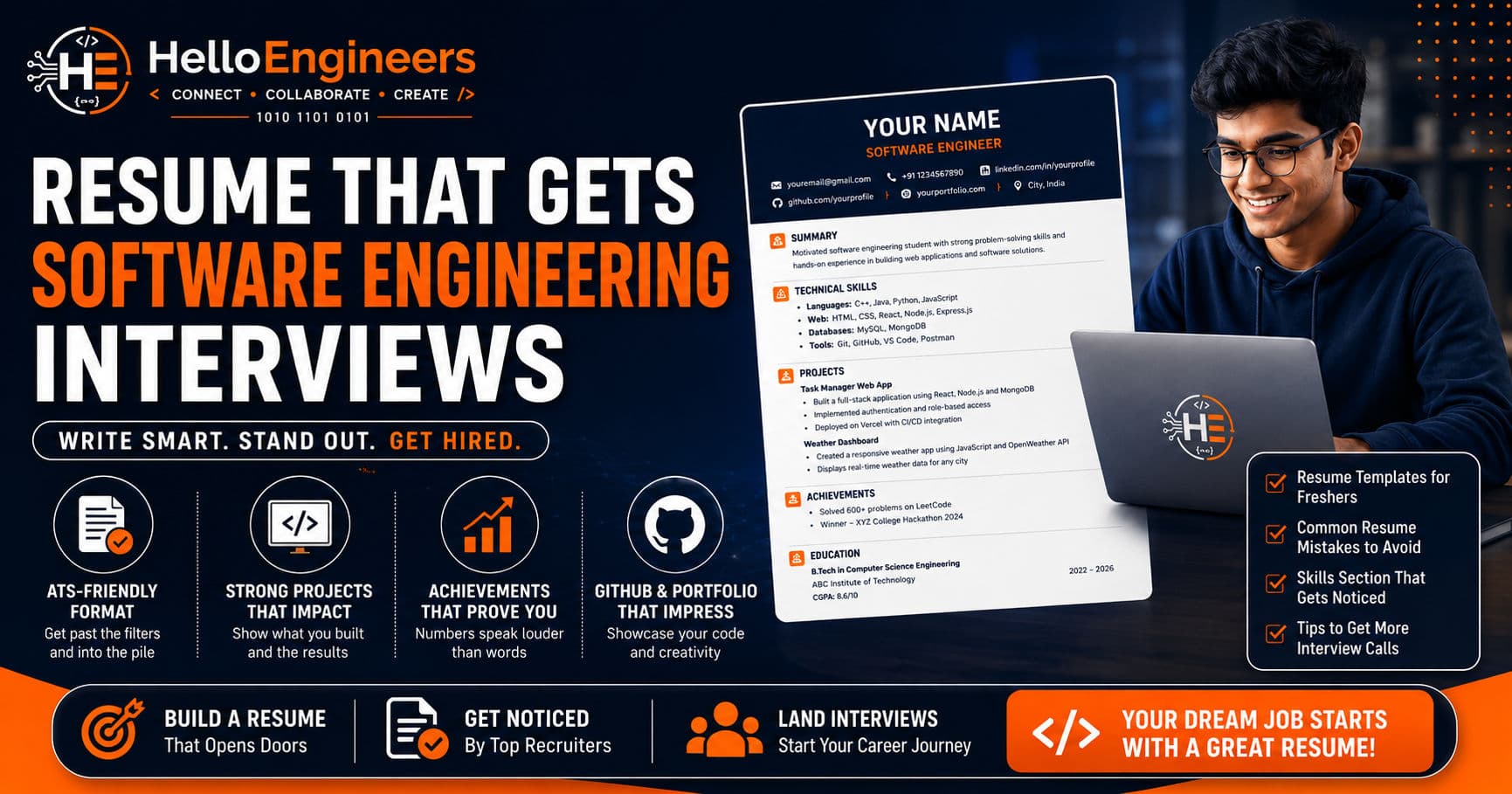
A clean software engineering resume format usually follows this order: contact information, a short summary, technical skills, work experience or projects, and education. Freshers might swap the order slightly, putting projects and education higher since they don't have much work history to lean on yet.
Keep it to one page if you have under five years of experience. Recruiters spend around six to eight seconds on an initial scan — that number gets thrown around a lot, and while the exact figure is debated, the point stands: nobody is reading paragraph after paragraph on their first pass. Bullet points, not blocks of text. Reverse chronological order, so your most recent and relevant work comes first.
A quick note on the summary line at the top: skip generic openers like "Hardworking software engineer seeking opportunities to grow." It says nothing. Instead, try something specific: "Backend engineer with 3 years building Java microservices for fintech systems processing 2M+ daily transactions." That single sentence tells a recruiter more than three vague ones combined.
Writing Project Descriptions That Actually Impress
This is where most engineers, especially students and freshers, lose points without realizing it. A project listed as "Built a to-do app using React" tells the reader almost nothing about what you actually did or how well you did it.
Better project descriptions answer three questions: what problem did the project solve, what did you build and with what tools, and what was the result? For example:
"Built a task-management app (React, Node.js, MongoDB) used by 40+ beta testers; added JWT authentication and cut page-load time by 35% through lazy loading and code splitting."
That one line shows scope, tech stack, and a measurable outcome. It reads like something a real person actually did, not a line item copied from a syllabus. If a project is open source or came from a hackathon, say so — it adds context and signals initiative.
Try to keep each project to two or three bullet points. Recruiters and hiring managers don't need every implementation detail; they need enough to ask a smart follow-up question in the interview.
Turning Duties Into Achievements
There's a difference between listing what your job involved and showing what you accomplished in it. "Responsible for maintaining backend services" is a duty. "Reduced API response time by 40% by refactoring database queries and adding caching" is an achievement. The second one is far more convincing, and it's the kind of line that gets remembered.
Numbers help, but they're not mandatory for every bullet. If you genuinely can't quantify something — say, mentoring a junior developer — describe the outcome instead: "Mentored two junior developers, both of whom were promoted within a year." Where you can measure impact, do it. Where you can't, be specific about the result rather than the task.
A good trick: for each bullet, ask "so what?" If the answer isn't obvious, rewrite it until it is.
Building a Skills Section Recruiters Trust
The skills section on a software engineering resume often gets treated as a dumping ground — every language, framework, and tool the person has ever touched, listed with no context. Recruiters have learned to be skeptical of a list with thirty items on it.
Group skills by category instead of listing them all together: Languages, Frameworks/Libraries, Tools & Platforms, Databases. Only include what you can actually speak to in an interview. If a recruiter asks you to explain a concept from your skills list and you go blank, that's a worse outcome than leaving it off entirely.
Order matters too. Put your strongest and most job-relevant skills first, since that's what gets scanned by both ATS keyword matching and a human's eye. If the job posting mentions specific technologies, and you genuinely have experience with them, make sure those exact terms appear somewhere in your resume — ATS systems often match on literal keywords, not synonyms.
Should You Add GitHub Links and a Portfolio?
Yes, almost always. A GitHub link gives recruiters and interviewers a way to verify your claims and see your actual code, not just your description of it. Make sure the profile is worth visiting: pin your best repositories, write real README files explaining what each project does and how to run it, and avoid leaving half-finished assignments as the first thing someone sees.
A portfolio site is optional but useful, especially for frontend roles or freelance work where visual presentation matters. It doesn't need to be elaborate — a single page with project screenshots, brief write-ups, and links to live demos and code repositories does the job. Put both links near your contact information at the top so they're impossible to miss.
One caution: don't link to a GitHub profile with nothing but forked repositories and no commits. An empty or inactive profile can hurt more than having none at all.
Common Resume Mistakes to Avoid
A few patterns show up again and again in software engineering resumes that don't get interviews:
- Generic objective statements that could apply to any candidate for any job.
- Listing responsibilities instead of results, especially for internships and past roles.
- Typos and inconsistent formatting — different bullet styles, mismatched date formats, or a font that changes halfway down the page.
- Overloading the skills section with every technology ever used, including ones from a single tutorial years ago.
- No quantifiable outcomes anywhere on the resume, even in places where a rough estimate would have worked.
- Resumes longer than needed for the experience level, padded with filler to look more substantial.
- Missing contact links like GitHub, LinkedIn, or a portfolio, or links that are broken.
Fixing even three or four of these can noticeably change how many callbacks you get.
Sample Resume Template for Freshers
If you're a fresher without much professional experience, structure your resume around what you do have: education, projects, and any internships or coursework that show real skill.
Header: Full name, phone number, email, city, GitHub link, portfolio link (if you have one).
Summary (2 lines): "Final-year Computer Science student with hands-on experience in full-stack development. Built and deployed three projects using React, Node.js, and PostgreSQL."
Skills: Group by category as discussed above — Languages, Frameworks, Tools, Databases.
Projects (2–3, with bullet points each): Name, tech stack, one-line description, and one or two bullets on what you built and the measurable result.
Education: Degree, institution, graduation year, and relevant coursework or GPA if strong.
Internships/Certifications (if any): Company or platform name, duration, and one or two lines on what you actually did or learned.
This structure keeps a fresher's software engineering resume focused on demonstrable skill rather than years of experience they don't yet have. It's honest about where they are in their career while still giving recruiters concrete reasons to move them forward.
Writing a resume that gets interviews isn't about tricking a system or padding a page with buzzwords. It's about being specific, being honest about your impact, and making it easy for both a bot and a human to see what you can actually do. Revisit it every few months, update it as your projects grow, and it'll keep working for you long after the first job offer comes in.
Frequently Asked Questions
1. What is an ATS-friendly software engineering resume?
It's a resume formatted so Applicant Tracking Systems can correctly read and parse the content — meaning no tables, graphics, or unusual fonts, and standard section headers that the software recognizes.
2. How long should a software engineering resume be?
One page for freshers and engineers with under five years of experience. Two pages is acceptable only if you have substantial, relevant experience that genuinely doesn't fit on one.
3. Should freshers include projects on their resume?
Yes. Projects often carry the most weight for freshers since they show applied skill in the absence of a long work history. Two or three well-described projects are usually enough.
4. Is it necessary to add a GitHub link on a resume?
It's strongly recommended, especially for engineering roles. A clean, active GitHub profile lets recruiters verify your work and gives interviewers something concrete to discuss.
5. What file format is best for an ATS-friendly resume?
A .docx file or a text-based PDF (not a scanned image or a heavily designed export) parses most reliably across different ATS platforms.
6. How do I show achievements if I don't have exact numbers?
Describe the outcome as specifically as possible even without a percentage or metric — for example, naming what improved, who benefited, or what changed as a result of your work.
7. Should I list every programming language I've ever used?
No. Only include skills you can confidently discuss in an interview. A shorter, honest list builds more trust than a long one padded with things you barely remember.
8. Do resume templates from Canva or Word work well for tech jobs?
Some do, but many use columns, icons, or text boxes that ATS software struggles to parse correctly. Simple, single-column templates built for parsing are usually a safer choice for software engineering resumes.