What is generative AI?
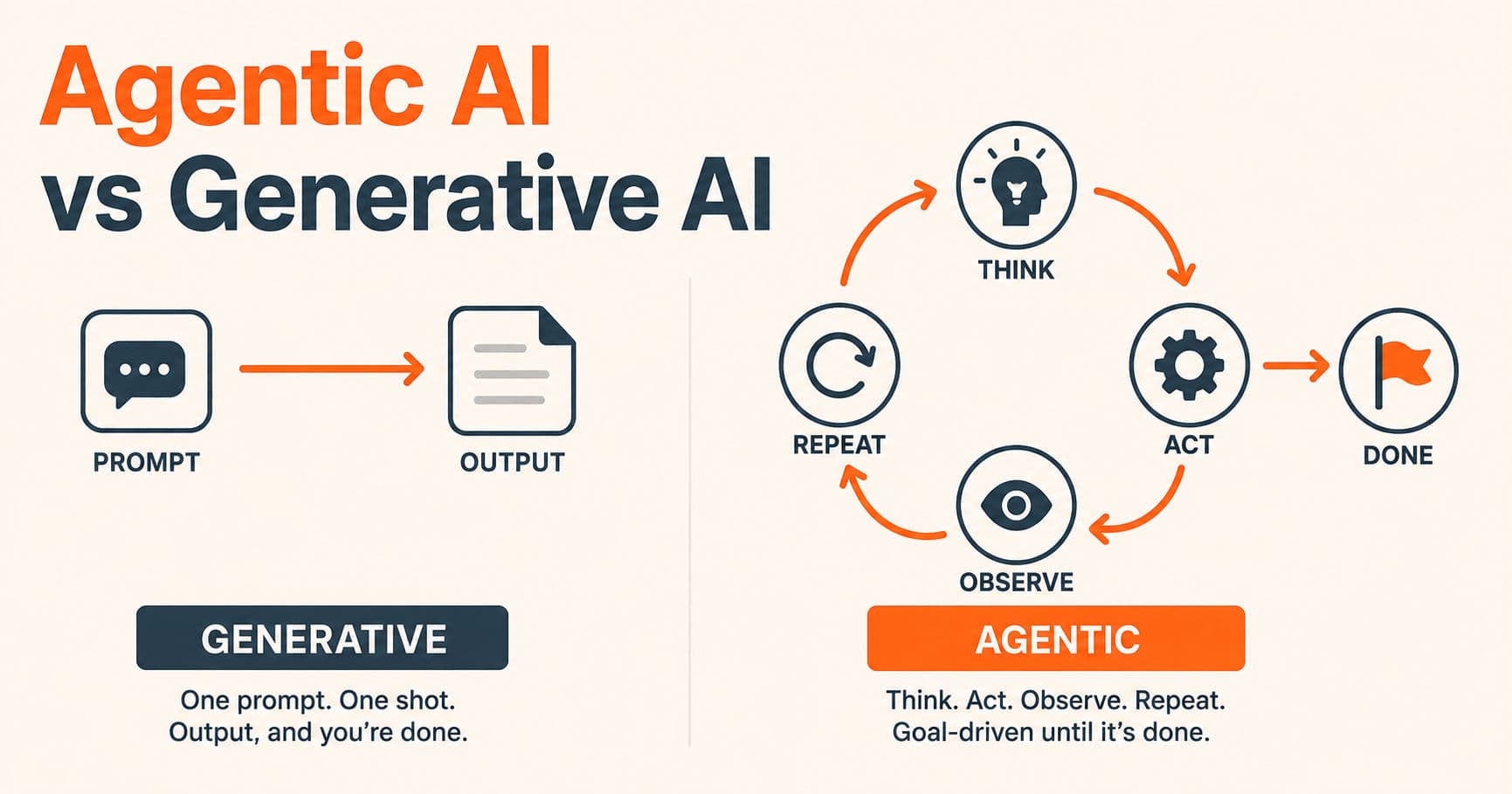
Generative AI is a class of models that produce new content — text, images, audio, video, or code — in response to a prompt. You give it an input, it returns an output, and the interaction ends there.
The defining property is that it is reactive. A generative model does not decide to do anything. It does not check whether its answer was correct, look something up, or take a second attempt unless you ask for one. Every action it takes is triggered by you.
Under the hood, a large language model predicts the next token based on patterns learned during training. That prediction is extremely capable, but it is still a single pass: input goes in, output comes out, and nothing in the world changes as a result.
Familiar examples: asking a chatbot to explain recursion, generating an image from a description, or having a model write a function from a comment. In each case a human reads the output and decides what to do next.
What is agentic AI?
Agentic AI is a system that pursues a goal on its own by planning steps, calling external tools, observing the results, and deciding what to do next until the goal is met or it gives up.
The defining property is that it is goal-directed. You give it an objective rather than an instruction. "Summarise this paragraph" is a generative prompt. "Find the three cheapest flights next Tuesday and put them in a spreadsheet" is an agentic goal, because getting there requires several actions, and the system has to work out which ones.
An AI agent has four parts:
-
A model — usually a generative language model, doing the reasoning and deciding the next action.
-
Tools — functions the agent is allowed to call: a search API, a database query, a file write, a calculator, an email sender.
-
Memory — some record of what has happened so far, so step four knows what step two found.
-
A loop — the control flow that repeats think-act-observe until a stopping condition is reached.
The crucial point that most explanations bury: an agent is not a more advanced model. It is the same kind of model wrapped in a program that lets it act repeatedly. The intelligence is largely the same; the architecture around it is what changed.
What is the difference between agentic AI and generative AI?
The difference between agentic AI and generative AI is that generative AI creates content in a single reactive step, while agentic AI takes a sequence of autonomous actions to reach a goal. Here is the comparison across the seven dimensions that actually matter:
| Dimension | Generative AI | Agentic AI |
|---|---|---|
| Trigger | Your prompt | A goal you set once |
| Steps | One | Many, decided at runtime |
| Tools | None | Calls APIs, databases, files |
| Memory | Within one conversation | Carried across steps |
| Output | Content | Completed actions |
| Failure mode | A wrong answer | A wrong action |
| Cost per task | One model call | Many model calls |
The row worth sitting with is the failure mode. When generative AI is wrong, you read something incorrect and decide whether to trust it. When agentic AI is wrong, it has already sent the email, updated the record, or deleted the file. The technology shifts from informational risk to operational risk, and that single change drives most of the engineering work in real agent systems.
A second point that gets lost in the "versus" framing: they are not alternatives. Agentic systems use generative models as their reasoning component. Asking whether to use agentic or generative AI is a bit like asking whether to use an engine or a car.
How does an AI agent actually work?
An AI agent works by running a loop: the model receives the goal and the history so far, chooses one action, the program executes that action, the result is added to the history, and the loop repeats until the model says it is finished or a step limit is hit.
Written as steps:
-
Receive the goal. The user states an objective once.
-
Think. The model looks at the goal, the available tools, and everything observed so far, then picks the next action.
-
Act. The program executes the chosen tool call. This is ordinary code, not AI — the model only decides which function runs and with what arguments.
-
Observe. The tool's return value goes back into the history as text.
-
Repeat or stop. If the goal is met, the model returns a final answer. If not, the loop returns to step 2. A hard step limit prevents it running forever.
Everything else in the agent ecosystem is refinement on this loop. Multi-agent systems run several of these loops and let them pass results to each other. Frameworks like LangGraph, CrewAI, and the various vendor agent SDKs give you state management, retries, human approval points, and observability so you do not write all of it yourself. The Model Context Protocol (MCP), introduced by Anthropic in 2024, standardises how tools are described so the same tool works across different frameworks.
None of that changes the underlying idea. If you understand the loop, you understand agents, and every framework becomes a question of convenience rather than concept.
Same task, two ways: generative and agentic in Python
This is the part no comparison article gives you. Below is the same task solved both ways, deliberately written without any agent framework so the mechanics stay visible.
Target: Python 3.10+. The call_model function is a stub — swap in whichever provider SDK you use, since API surfaces change frequently and pinning one here would date the example. The tool functions run as written.
The task
"Look at the marks for student S102, work out the average, and tell me whether they are above the class average."
Version 1 — Generative AI
# One call in, one answer out. The model takes no action.
from provider import call_model # your LLM client wrapper
marks_text = """
S101: 78, 65, 90
S102: 55, 62, 71
S103: 88, 91, 79
"""
prompt = f"""Here are class marks:
{marks_text}
Work out S102's average and say whether it is above the class average."""
print(call_model([{"role": "user", "content": prompt}]))
This works, with one important caveat: the model is doing the arithmetic by predicting tokens, not by calculating. On small numbers it is usually right. On a hundred students it will quietly make mistakes, and you will not know which ones.
Version 2 — Agentic AI

# agent.py
# A goal in, a sequence of tool calls, an answer out.
import json
from provider import call_model # your LLM client wrapper
MARKS = {
"S101": [78, 65, 90],
"S102": [55, 62, 71],
"S103": [88, 91, 79],
}
# ---- 1. TOOLS: the only things this agent is allowed to do ----
def get_marks(student_id: str) -> list:
"""Return the marks list for one student."""
return MARKS.get(student_id, [])
def average(numbers: list) -> float:
"""Return the mean of a list of numbers."""
return round(sum(numbers) / len(numbers), 2) if numbers else 0.0
def class_average() -> float:
"""Return the mean across every student."""
all_marks = [m for marks in MARKS.values() for m in marks]
return round(sum(all_marks) / len(all_marks), 2)
TOOLS = {
"get_marks": get_marks,
"average": average,
"class_average": class_average,
}
# agent.py (continued)
SYSTEM = """You are an agent. Reply with JSON only, no prose.
Available tools:
get_marks(student_id: str) -> list
average(numbers: list) -> float
class_average() -> float
To use a tool: {"tool": "<name>", "args": {...}}
When finished: {"tool": "finish", "args": {"answer": "<your answer>"}}
""" def run_agent(goal: str, max_steps: int = 6) -> str:
history = [
{"role": "system", "content": SYSTEM},
{"role": "user", "content": goal},
]
for step in range(max_steps):
reply = call_model(history) # THINK
action = json.loads(reply)
if action["tool"] == "finish": # STOP
return action["args"]["answer"]
result = TOOLS[action["tool"]](**action["args"]) # ACT
history.append({"role": "assistant", "content": reply})
history.append({ # OBSERVE
"role": "user",
"content": f"Tool result: {result}",
})
return "Stopped: step limit reached."
print(run_agent("Is S102 above the class average?"))
What actually changed
Read the two files side by side and the difference is concrete rather than philosophical:
-
The generative version has no for loop. One call, done.
-
The agentic version has a TOOLS dictionary. That dictionary is the agent's entire permission set. Anything not in it, the agent cannot do. This is where security lives.
-
Arithmetic moved out of the model. average() is ordinary Python, so it is exactly right every time. Well-built agents push anything verifiable into real code and use the model only for deciding.
-
max_steps exists. Without it, a confused agent loops forever and bills you for every iteration. Every production agent has this cap.
-
The history grows. Each observation is appended, which is the memory that lets step four use what step two found.
If you build this once and watch the loop print each step, agentic AI stops being a buzzword. It is about fifty lines of control flow around a model you already know how to call.
When should you use each one?
Choosing between generative and agentic approaches comes down to whether the task is one step or several, and whether being wrong is expensive.
Use generative AI when:
-
The task is a single transformation: summarise, translate, rewrite, explain, draft.
-
A human will read the output before anything happens because of it.
-
You need speed and low cost, since it is one model call.
-
The task is creative and the "right answer" is a matter of judgement.
Use agentic AI when:
-
The task genuinely needs several steps, and the steps depend on what earlier steps found.
-
Real data has to be fetched rather than recalled from training.
-
The work is repetitive enough that supervising each step defeats the point.
-
You can define a clear stopping condition and a bounded set of tools.
Use neither when: the task is deterministic. If a SQL query or a Python script gives you the exact answer every time, use the query. A surprising share of "AI projects" are cron jobs with extra latency and a monthly bill.
What agentic AI gets wrong
Agentic AI has real, structural weaknesses. Naming them is the fastest way to sound like someone who has built one rather than read about one.
Errors compound across steps. This is the big one, and it is arithmetic rather than opinion. If each step succeeds 90% of the time, a ten-step task succeeds about 35% of the time end to end, because 0.9 raised to the tenth power is roughly 0.35. Pushing per-step reliability to 95% only lifts you to about 60%. This is why serious agent work is mostly about reducing step count and making individual steps deterministic, not about better prompts.
Cost multiplies. A generative task is one model call. An agent might make eight to fifteen, each carrying the growing history as input. The same task can cost an order of magnitude more.
The failure mode is action, not text. A hallucinating chatbot produces a wrong sentence. A hallucinating agent with database access produces a wrong write. Anything with real consequences needs a human approval step, which is exactly what the frameworks call human-in-the-loop.
Prompt injection becomes an action risk. If your agent reads a web page or an email, whatever text is in there enters its context. Malicious instructions hidden in that content can influence what the agent does next. When the agent can only talk, this is embarrassing. When it can send emails, it is a security incident.
Debugging is genuinely hard. The same goal can produce different action sequences on different runs. Reproducing a failure means logging every step, every tool call, and every result, which is why observability tooling appeared so quickly in this space.
It is often unnecessary. Many workflows presented as agentic are fixed sequences that a normal script handles better. If you already know the order of the steps, you do not need a model to decide it.
What this means for engineering students in India
The practical read for a student: agentic AI has not created a new subject to learn. It has raised the value of software engineering fundamentals you were already supposed to have.
Building a working agent requires almost no machine learning. It requires Python, API calls, JSON handling, error handling, and clear thinking about control flow. A student who can write clean Python and reason about failure cases can build a real agent in a weekend. A student who only knows how to prompt a chatbot cannot.
What this changes about what is worth learning:
-
API and tool integration matters more. The interesting work is connecting a model to real systems safely, and that is backend engineering.
-
Error handling stops being optional. In a single generative call, an exception is a bad response. In a loop, an unhandled exception at step three wastes every call before it.
-
Understanding cost and latency matters. Every loop iteration is money and seconds. Students who never think about this build demos that cannot ship.
-
Prompting alone is not a skill worth listing. It was briefly, and it is not any more. What is defensible on a resume is a working system you built and can explain.
One caution about hype. Agentic AI is currently being marketed hard, and much of what is described as an agent is a scripted workflow with a model call in it. Being able to tell the difference is itself a signal in an interview, and saying "this could have been a cron job" about a real example is more impressive than reciting definitions.
What to build to show you understand agents
Three projects, ordered by difficulty. Build one properly rather than three halfway.
1. The no-framework agent loop. Write the fifty-line loop above yourself, with three tools of your own and a step limit. Print every step. This proves you understand the mechanism rather than a library's API, and it is the one interviewers can probe most usefully.
2. A research agent with a real tool. Give it web search or a public API, a goal that needs two or three lookups, and a written report as output. Log every tool call and include one failed run in your README with an explanation of why it failed. That failure section will get you more credit than a clean demo.
3. An agent with a human approval gate. Any agent that performs a real action — sending an email, writing to a database, posting a message — with a step that pauses and asks a human to approve before executing. This is the pattern production systems actually use, and almost no student project has it.
For all three: put the tool definitions in one obvious place, keep API keys in environment variables rather than the repository, and write a README that states what the agent can and cannot do. A README that honestly lists the limitations reads as engineering maturity.
Common misconceptions
| Misconception | Why people believe it | Reality |
|---|---|---|
| Agentic AI is a smarter model | The word sounds like a capability upgrade | It is the same model inside a loop with tools |
| Agents replace generative AI | The "versus" framing in most articles | Agents use generative models as their reasoning core |
| You need a framework to build one | Frameworks dominate the conversation | A working agent is under 60 lines of plain Python |
| More autonomy is always better | Autonomy is the headline feature | More steps means compounding failure; fewer steps is usually better |
| Agents learn from their mistakes | "Adapts over time" appears in marketing copy | Most adapt within a run only; the model itself is unchanged |
| Prompt engineering is the core skill | It was the entry point for many people | Tool design, error handling, and control flow matter more |
| Any multi-step AI workflow is an agent | Vendors label everything agentic | If you fixed the sequence in advance, it is a script |
Frequently asked questions
Is agentic AI just generative AI with extra steps?
Partly, and that framing is more accurate than most marketing. Agentic AI uses a generative model as its reasoning component, then adds tools, memory, and a loop that repeats until a goal is met. The model is not more capable; the software around it lets that capability take actions.
Can generative AI and agentic AI work together?
They already do. Almost every agentic system uses a generative model to decide each next action and to write its final output. The agent layer handles sequencing, memory, and tool execution, while the generative layer handles reasoning and language. They are layered, not competing.
Do I need to know machine learning to build an AI agent?
No. Building an agent requires Python, API calls, JSON handling, and error handling, not model training. You call an existing model through an API rather than building one. Machine learning knowledge helps you understand why models fail, but it is not a prerequisite for writing a working agent.
Which is better, agentic AI or generative AI?
Neither is better; they suit different tasks. Use generative AI for single-step content work where a human reviews the output. Use agentic AI for multi-step tasks that need real data and where supervising each step would defeat the purpose. Many systems use both together.
What are examples of agentic AI?
Coding assistants that read your repository, run tests, and fix failures across several steps. Research assistants that search, read, and compile a report. Customer-support systems that look up an order, check a policy, and issue a refund. Each one plans, calls tools, and acts rather than only producing text.
Is agentic AI safe to use in production?
It can be, with controls. Production agents restrict which tools an agent can call, cap the number of steps, log every action, and require human approval before anything irreversible. The risk is different from generative AI: a wrong output becomes a wrong action, so the safeguards sit around actions rather than around text.
What is MCP in agentic AI?
MCP stands for Model Context Protocol, an open standard introduced by Anthropic in 2024 for describing tools to AI models. Before it, every framework defined tools its own way and code was not portable. MCP lets you define a tool once and use it across different frameworks and models.
Should students learn LangGraph or CrewAI?
Build the loop yourself first, then pick a framework when you hit a problem it solves. Frameworks in this space change fast, so understanding the underlying pattern outlasts any specific library. Once you know why state management and retries matter, learning any framework takes days.
Will agentic AI take entry-level developer jobs?
It changes what entry-level work looks like more than it removes it. Writing routine code is faster now, so the value shifts toward reviewing, debugging, integrating, and deciding what to build. Those are the skills worth investing in, and they are harder to automate than code generation.
Conclusion
The distinction is simpler than the marketing suggests: generative AI writes, agentic AI acts, and the second one uses the first inside a loop.
If you take one thing from this, make it the compounding-reliability point. A ten-step agent with 90% reliable steps fails most of the time, and understanding that changes how you design systems and how you talk about them in an interview.
Build the fifty-line loop this week. It is a Sunday afternoon of work, and it converts agentic AI from a term you have read about into a thing you have made.