Introduction
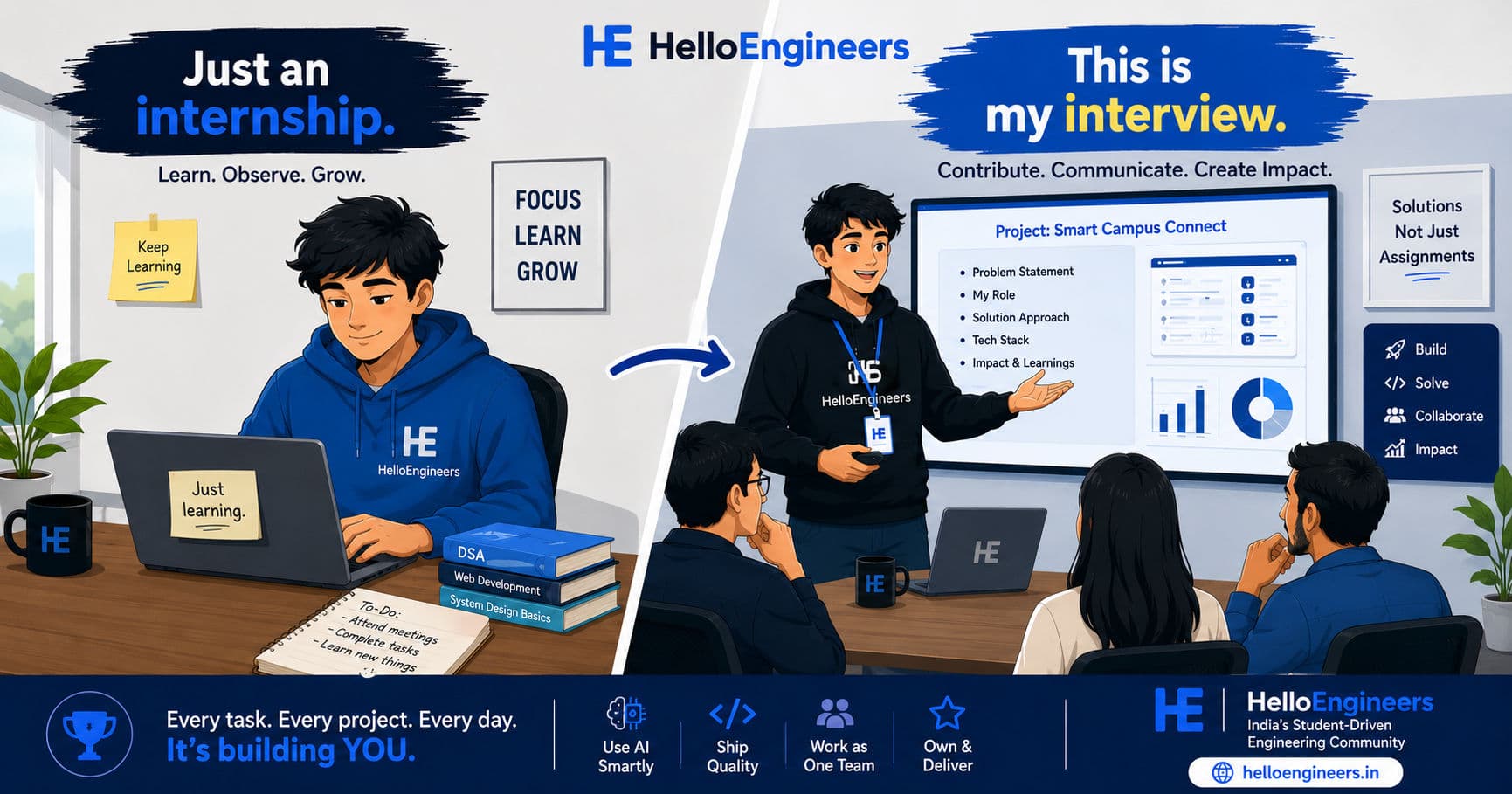
For years, engineering students treated internships as a checkbox — something to add to a resume before the "real" placement season began. That assumption is no longer safe. In 2026, internships have quietly become the primary hiring funnel for entry-level tech talent, with companies converting interns into full-time employees through Pre-Placement Offers (PPOs) at a scale that dwarfs traditional campus drives.
If you're an engineering student, fresher, or job seeker heading into an internship this year, understanding this shift isn't optional — it directly changes how you should prepare, behave, and perform once you're in the door. This article breaks down what's changed, why it's happening, and exactly what you need to do to convert your internship into an offer.
Table of Contents
1. Why Internships Have Replaced Traditional Placements
2. The Data Behind the Shift
3. What Recruiters Actually Look For in 2026
4. How to Become an "AI-Augmented" Intern
5. In-Person vs Remote: Why Presence Still Wins
6. A Practical 90-Day Internship Game Plan
7. Common Mistakes That Cost Students a PPO
8. FAQs
9. Conclusion
Why Internships Have Replaced Traditional Placements
Traditionally, students spent three to four years building a resume for a single, high-pressure placement season in their final year. Companies would visit campuses, run rounds of tests and interviews, and hire in bulk within a few weeks.
That model is breaking down. Hiring has become more continuous and risk-averse. Instead of betting on a resume and two interview rounds, companies now prefer to "trial" a candidate over two to six months as an intern, watch how they actually work, and then extend a full-time offer only to those who've already proven themselves. It's a lower-risk, higher-confidence way to hire — for the company. For students, it means the stakes of an internship are now much higher than they used to be.
The Data Behind the Shift
Recent industry data backs up what recruiters are increasingly saying out loud: nearly 40-60% of entry-level roles at many companies are now filled through PPOs given to former interns, not through fresh placement drives. That leaves a shrinking number of seats for students who skip internships or treat them casually and hope to compete at the final placement stage instead.
This isn't limited to large corporations. Mid-sized companies — those with 200 to 1,000 employees — are increasingly popular among students specifically because they offer more hands-on work and closer mentorship, both of which improve a student's odds of standing out enough to earn a PPO.
What Recruiters Actually Look For in 2026
The bar for a "good intern" has moved. It's no longer just about writing correct code or completing assigned tasks. Recruiters in 2026 are evaluating interns on:
Ownership — Can you take a task from unclear requirements to a finished, working result without being micromanaged?
Communication — Can you explain your reasoning, ask good questions, and update your team without being chased?
Adaptability — Can you pick up a new tool, framework, or codebase quickly?
AI fluency — Can you use AI coding assistants to move faster, without losing the ability to explain or debug what was built?
Reliability — Do you show up, meet deadlines, and follow through?
Technical skill alone is now the entry ticket, not the differentiator.
How to Become an "AI-Augmented" Intern
One of the clearest shifts in 2026 hiring is that companies are no longer neutral about AI tool usage — they expect it. Interns who use tools like GitHub Copilot, Claude, or ChatGPT to write boilerplate faster, debug quicker, and research unfamiliar concepts are seen as more productive, not less capable.
But there's a catch. Recruiters are also wary of interns who lean on AI tools without understanding the output. The interns who actually earn PPOs are the ones who can:
Use AI to accelerate routine work (setup, boilerplate, documentation, test writing)
Still explain every line of logic in their own words during a code review
Use AI as a research and debugging partner, not a replacement for thinking
Ship working, tested features — not just code that compiles
If you're preparing for an internship, spend time practicing with AI coding tools now, so you're comfortable using them productively from day one, and equally comfortable defending your decisions without them.
In-Person vs Remote: Why Presence Still Wins
Data from 2026 internship surveys shows a meaningful gap: in-person interns receive PPOs at a noticeably higher rate than remote or hybrid interns. This doesn't mean remote internships aren't valuable, but it does mean visibility matters more than students often assume.
In-person interns naturally get more informal mentorship, more chances to ask quick questions, and more opportunities to be noticed by senior engineers and managers. If you have the option between a remote and an in-person internship of similar quality, the data suggests choosing in-person will meaningfully improve your conversion odds.
If your internship is remote, compensate deliberately: turn your camera on in calls, over-communicate progress, and proactively schedule short check-ins with your manager instead of waiting to be asked.
A Practical 90-Day Internship Game Plan
Days 1-15: Learn fast, ask smart questions
Understand the codebase, the team's workflow, and what "good work" looks like on this specific team. Don't try to impress yet — try to understand.
Days 16-45: Ship visible, complete work
Pick tasks you can finish end-to-end. A small feature shipped completely beats a big feature left half-done. Document what you did.
Days 46-75: Take initiative
Suggest improvements, fix small bugs you notice unprompted, offer to help teammates. This is where you shift from "intern doing tasks" to "person the team relies on."
Days 76-90: Make your case
Prepare a short summary of what you built and learned. If a PPO conversation hasn't started, it's reasonable to ask your manager directly what the path to a full-time offer looks like.
Common Mistakes That Cost Students a PPO
Treating the internship as low-stakes because it's "not the real job"
Staying silent when confused instead of asking questions
Avoiding AI tools out of fear of looking unskilled — or over-relying on them without understanding the code
Doing only what's assigned and never showing initiative
Failing to build relationships with the team beyond the immediate manager
FAQs
Q: Is it bad to use AI tools during my internship?
No. In 2026, most companies expect interns to use AI coding assistants. What matters is that you can explain and justify the code you ship, not that you avoid the tools.
Q: Should I choose an in-person internship over a remote one?
If both offer similar learning value, in-person internships currently convert to full-time offers at a higher rate, largely due to stronger mentorship and visibility.
Q: What if my internship is unpaid or low-paying?
Focus on the learning and mentorship quality first. Most students today value hands-on experience and growth over pay alone, especially at the internship stage.
Q: How early should I start preparing for an internship?
Ideally, months before you apply — build a portfolio of small, complete projects, get comfortable with AI-assisted development, and practice explaining your technical decisions clearly.
Q: Does a mid-sized company internship help more than a big brand internship?
Not necessarily more, but often differently. Mid-sized companies tend to offer closer mentorship and broader ownership, which can accelerate learning faster than a narrow role at a large company.
Conclusion
The rules of getting hired have quietly changed. Internships are no longer a formality before the "real" placement process — for a large and growing share of students, the internship is the placement process. Treating it with intention, showing up (physically when possible), using AI tools intelligently, and taking ownership of real work are now the clearest paths to converting an internship into a full-time career.
If you're an engineering student preparing for your next internship, this is the moment to shift your mindset — and communities like HelloEngineers exist to help you make that shift practically, through real projects, mentorship, and peer networks.