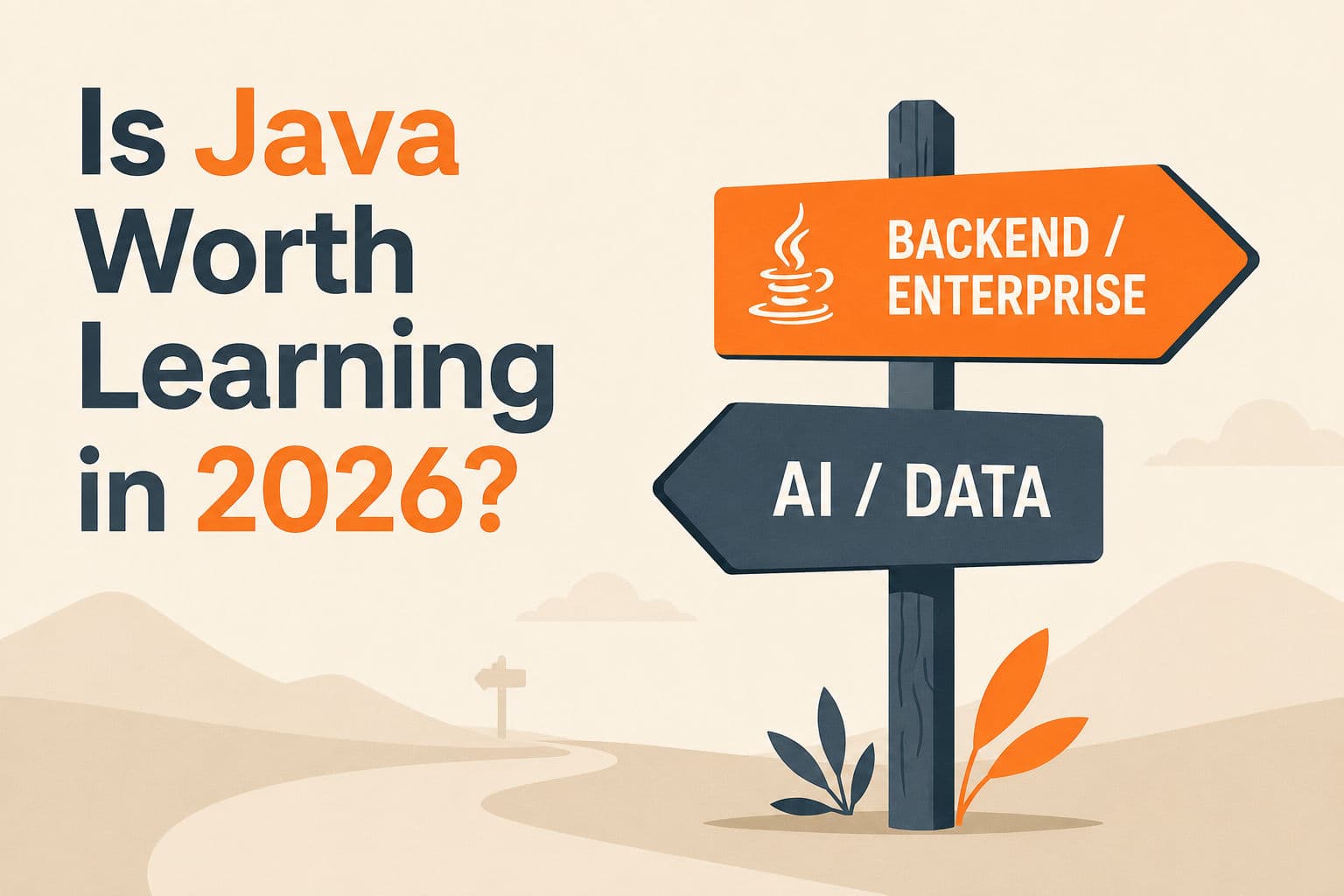
What is Java and why does it still matter?
Java is a general-purpose, object-oriented, statically typed programming language that compiles to bytecode and runs on the Java Virtual Machine (JVM). Statically typed means the compiler checks your variable types before the program runs, so a whole class of mistakes gets caught at compile time rather than in production.
The reason Java still matters after three decades is not nostalgia. It is that the JVM made "write once, run anywhere" real, and enterprises built their core systems on that promise. Banking systems, insurance platforms, telecom billing, airline reservations, and government portals were written in Java and are still running, still being extended, and still being staffed.
That creates a specific kind of job market. Java demand is less about new startups picking it and more about the enormous installed base that needs maintaining, modernising, and extending. For an Indian engineering student, that installed base is the point, because Indian IT services companies are the ones maintaining a large share of it.
Java is also actively developed, not frozen. Oracle ships a new version every six months and designates a Long-Term Support release roughly every two years. JDK 25 is the current LTS. Modern Java has lambda expressions, streams, records, sealed classes, pattern matching in switch, and virtual threads. If your mental image of Java is fifty lines of boilerplate to read a file, that image is about a decade out of date.
Where is Java actually used in 2026?
Java runs in six places that matter for a student deciding what to learn:
-
Enterprise backend systems — Spring Boot is the dominant framework for building REST APIs and microservices in Java, and it is what most Indian backend job descriptions name.
-
Banking and financial services — BFSI systems in India are heavily Java, partly for the type safety and partly because rewriting a working core banking system is a decade-long project nobody wants to start.
-
Big data infrastructure — Apache Spark, Kafka, Flink, Hive, and Hadoop are JVM projects. Data engineers who never write application Java still read Java stack traces.
-
Android — existing Android apps contain large amounts of Java, even though Kotlin is now the recommended language for new work.
-
Enterprise middleware and integration — the layer that connects a bank's mainframe to its mobile app is very often Java.
-
Test automation — Selenium with Java and TestNG remains a standard combination in Indian QA teams, and it is a real entry route into tech.
Notice what is missing from that list: machine learning, data science, quick web prototypes, and modern frontend. Those belong to Python and JavaScript. Java is not competing there and pretending otherwise would waste your time.
Who should learn Java, and who should skip it?
Learn Java if any of these describe you:
-
You are preparing for Indian campus placements, especially at service companies. Java is one of the two or three languages every one of them accepts, and it is the language much of their client work is in.
-
You want a backend career. Java plus Spring Boot is one of the most reliably hireable combinations in India, and it stays hireable across economic cycles because the systems it runs cannot be switched off.
-
You are targeting BFSI, telecom, or large enterprise IT.
-
You want to understand how programs actually work. Static typing, explicit memory model, and compile-time errors teach you more about program structure than a dynamically typed language does at the same stage.
-
You are joining a team that maintains an existing Android app.
Skip Java, or postpone it, if:
-
Your goal is AI, machine learning, or data science. Learn Python. The entire ecosystem is there and Java gets you nowhere near it.
-
You want to build and ship a web product in the next two months. JavaScript with Node and React will get you there faster.
-
You are starting a new Android app from scratch. Google recommends Kotlin for new Android development, and job postings increasingly reflect that.
-
You have three weeks before placements start. Java is a depth language. Three weeks is enough to learn syntax, not enough to answer follow-up questions, and interviewers ask follow-up questions.
Java or Python for placements: which one first?
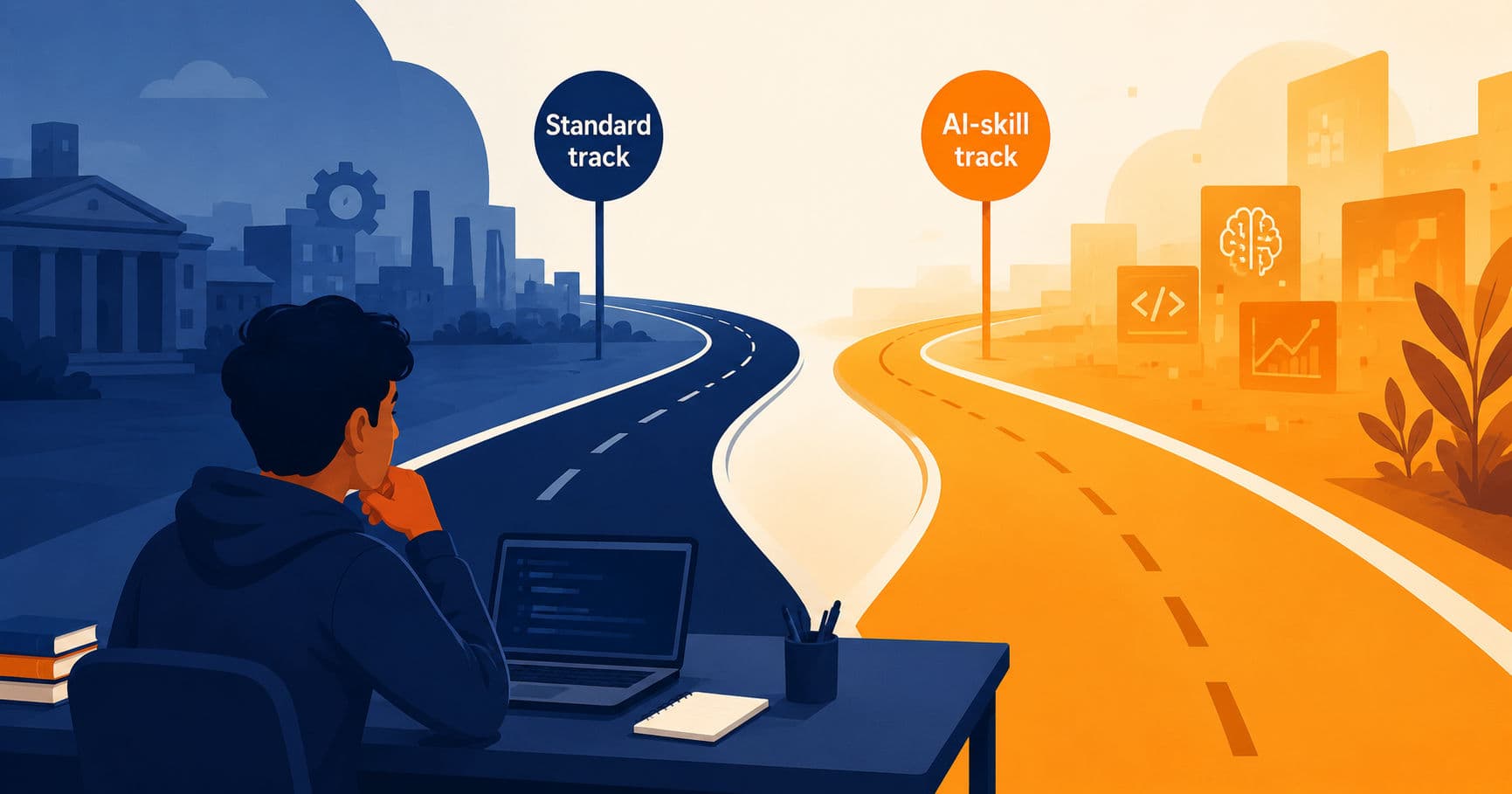
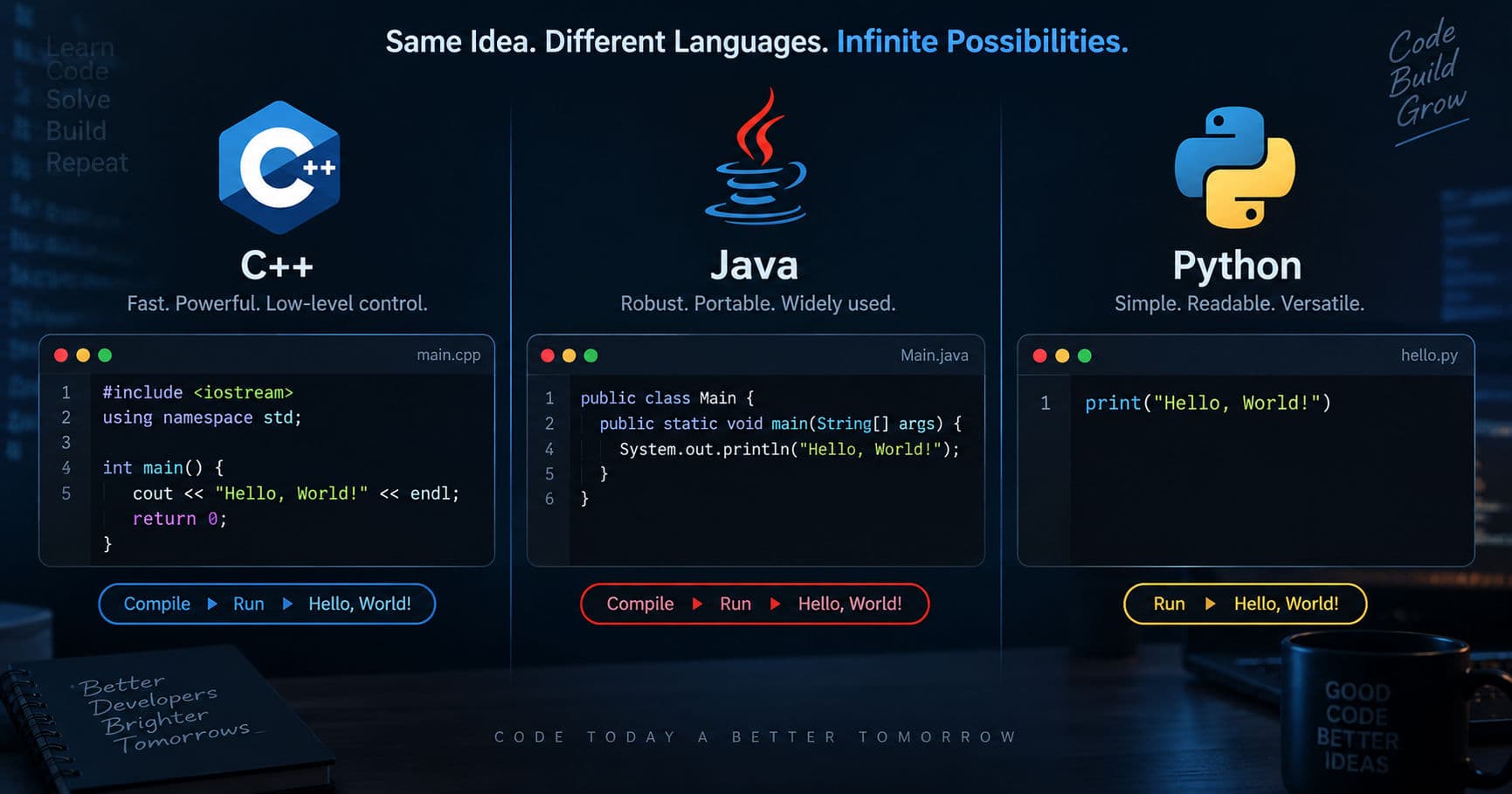
For Indian campus placements, pick the language that matches the roles you are targeting. Both are accepted in coding rounds at nearly every company, so this is a career-direction decision, not a rules decision.
[table]
For a student aiming at backend or enterprise roles, Java first is the better bet. For a student aiming at AI, data, or analytics roles, Python first, and Java only if a specific company you want requires it.
One thing that is not true: that you must pick forever. Most working developers use two or three languages. The question is only which one you go deep in first, because depth in one language is what interviews test.
What Java skills do Indian companies actually test?
Indian companies testing Java for fresher roles concentrate on a narrow, predictable set. Interview rounds rarely ask about exotic features; they ask whether you understand what happens underneath ordinary code.
The five areas that come up repeatedly:
-
Object-oriented fundamentals — classes, objects, inheritance, polymorphism, abstraction, encapsulation, and the difference between overloading and overriding. Expect to explain, not just define.
-
Collections framework — ArrayList versus LinkedList, HashMap versus TreeMap, how a HashMap actually stores and retrieves entries, and when hash collisions matter.
-
Strings and immutability — why String is immutable, what the string pool is, and when StringBuilder is the right choice.
-
Exception handling — checked versus unchecked exceptions, try-with-resources, and what finally guarantees.
-
Modern Java (Java 8 onwards) — lambda expressions, the Streams API, Optional, and functional interfaces. This is the section most students skip and most interviewers now ask about.
Beyond the language itself, backend roles expect SQL, basic REST API understanding, and Git. A candidate with solid core Java and no SQL gets rejected regularly.
For system-facing roles, add multithreading basics and, at the LTS level you are learning on, an awareness of virtual threads, which changed how Java handles concurrency at scale.
The 6-month Java placement roadmap
This roadmap assumes you can give Java about 8 to 10 hours a week alongside classes. It uses only free tools. Install the JDK (not just a runtime) and either IntelliJ IDEA Community Edition or VS Code with the Java extension pack.
| Month | Focus | What you should have at the end |
|---|---|---|
| 1 | Core syntax and OOP | 15-20 small programs, one console app |
| 2 | Collections, strings, exceptions | Comfortable with List, Map, Set |
| 3 | DSA in Java | 80-100 solved problems |
| 4 | Java 8+ features and SQL | Streams used naturally; basic joins written |
| 5 | Spring Boot REST API | One deployed API with a database |
| 6 | Interview preparation | Mock interviews, project polish |
Month 1 — Core syntax and object-oriented basics
Learn variables, data types, control flow, methods, arrays, and then classes and objects. Cover the four OOP pillars properly, with your own examples rather than the textbook Animal/Dog one.
Build one console application at the end. A library issue-return tracker or a simple bank account simulator is enough. Write it without following a tutorial line by line.
Version warning: most college labs still run JDK 8 or JDK 11. Install a recent LTS yourself. If you only ever write code that compiles in your lab, you will never encounter var, records, or enhanced switch, and those come up in interviews.
Month 2 — Collections, strings, and exceptions
Work through ArrayList, LinkedList, HashMap, HashSet, and TreeMap. For each one, learn what it costs: lookup time, insertion time, and when it degrades.
Then strings and immutability, then exception handling. Write deliberately broken programs and fix them. Reading a stack trace fluently is a skill you will use every working day.
Month 3 — Data structures and algorithms in Java
Start solving problems on a free judge. Arrays, strings, hashing, two pointers, sliding window, recursion, linked lists, stacks, queues, trees, and basic graphs, in roughly that order.
Aim for 80 to 100 problems, not 500. Understanding twenty problems deeply beats skimming two hundred.
A gotcha that costs marks: Scanner is slow for large inputs. On judges with tight time limits, reading with BufferedReader instead of Scanner is sometimes the entire difference between a passing and a timing-out submission.
Month 4 — Modern Java and SQL
Learn lambda expressions, functional interfaces, the Streams API, and Optional. Rewrite five programs from Month 2 using streams so you feel the difference rather than memorising syntax.
In parallel, learn SQL: SELECT, WHERE, GROUP BY, JOIN, and indexes. Install PostgreSQL or MySQL locally. Backend interviews test SQL almost as often as they test Java.
Month 5 — Spring Boot and one real project
Build one REST API with Spring Boot: a few endpoints, a database behind it, and proper error responses. A student attendance API, an expense tracker API, or a small job-listing API all work.
Deploy it. Render, Railway, or a free-tier cloud instance is fine. Put the repository link and the live URL in your resume. A deployed API with a README beats three tutorial clones sitting private on your machine.
Add tests with JUnit for at least your main service class. Most fresher projects have zero tests, so having any is a differentiator.
Month 6 — Interview preparation
Revise the five tested areas. Do timed coding practice. Then do mock interviews with a friend or a senior, out loud, because explaining a HashMap in your head is not the same as explaining it under pressure.
Rehearse your Spring Boot project until you can describe the design in two minutes: what it does, why you structured it that way, and what you would change.
Is Java still used for Android development?
Java is still present in Android development, but it is no longer the recommended language for new Android apps. Google made Kotlin its preferred Android language, and its official Android documentation is Kotlin-first.
What that means practically:
-
Starting Android from zero in 2026 — learn Kotlin. Most new tutorials, samples, and job descriptions assume it.
-
Joining a team with an existing Android app — Java knowledge is directly useful, because large production Android codebases still contain a lot of Java.
-
Already know Java and want Android — Kotlin runs on the JVM and interoperates with Java. Your Java knowledge transfers, and Kotlin takes weeks rather than months to pick up.
So "learn Java for Android" is outdated advice as a starting point, while "Java knowledge helps in Android jobs" remains true.
What learning Java will not do for you
Java is a good bet for specific outcomes and a poor one for others. Being clear about this saves months.
-
It will not get you into AI or machine learning roles. The libraries, the research code, and the hiring pipelines are all Python.
-
It will not get you hired by itself. A resume line reading "Java" with no project behind it is background noise. Companies hire people who have built something.
-
It will not make you fast at shipping. Java is verbose by design. That verbosity buys reliability at scale, which is a poor trade for a two-week prototype.
-
A certificate will not substitute for a project. Certifications are the easiest thing to acquire and therefore the weakest signal.
-
It will not compensate for weak DSA. Coding rounds test problem-solving. Your language choice affects how you type the answer, not whether you have one.
Common mistakes students make while learning Java
| Mistake | Why it happens | Fix |
|---|---|---|
| Learning only lab-version Java | The college runs JDK 8 or 11 | Install a current LTS yourself and learn streams, records, and var |
| Memorising definitions | Exams reward recall | Practise explaining out loud; interviewers ask "why", not "what" |
| Skipping the Streams API | It feels advanced | It is standard Java 8+ and comes up constantly in interviews |
| Watching tutorials without coding | Video feels like progress | Pause and rebuild every example yourself before moving on |
| Using Scanner in judged problems | It is what the first tutorial taught | Use BufferedReader for large inputs to avoid timing out |
| Learning Java but ignoring SQL | Feels like a separate subject | Learn joins in Month 4; backend interviews test both |
| Collecting certificates | They look like proof of effort | Build and deploy one Spring Boot project instead |
| Three tutorial-clone projects | Following along is easier than designing | One original deployed project outperforms three clones |
| Starting Android with Java | Old blog posts still recommend it | Start Android with Kotlin; keep Java for backend |
| Quitting at the DSA month | Month 3 is genuinely hard | Cut to two problems a day and keep the streak instead of stopping |
Should you learn Java? A decision checklist
Answer these honestly. Four or more yes answers means Java is a good use of your next six months.
-
Are you targeting backend, enterprise, or full-stack roles rather than AI or data science?
-
Will you be sitting for campus placements at Indian service companies?
-
Do you have at least three months before your placement season starts?
-
Are you interested in how systems work underneath, not only in shipping quickly?
-
Do the companies on your target list mention Java or Spring Boot in their job descriptions?
-
Are you willing to build and deploy one real project rather than collecting certificates?
-
Is BFSI, telecom, or large-enterprise IT somewhere you would be happy working?
If you answered no to most of these and yes to "I want to work in AI", learn Python first. That is not a failure of Java. It is the correct read of your own goals.
Frequently asked questions
Is Java still in demand in 2026?
Yes, particularly in India. Java remains a core language for backend and enterprise systems, and Indian IT services companies maintain very large Java codebases for clients in banking, insurance, and telecom. Demand is steadier than fashionable languages, though growth is concentrated in maintenance and modernisation rather than new greenfield projects.
Is Java hard to learn for beginners?
Java is moderately hard at the start and easier later. The syntax is more verbose than Python, so your first programs take longer to write. But static typing means the compiler catches mistakes before you run the code, which makes debugging simpler once you get past the first few weeks.
How long does it take to learn Java for placements?
Roughly three to six months at 8-10 hours a week. Core syntax and object-oriented basics take about two months, data structures another month, and Spring Boot with a real project two more. Three weeks is enough to learn syntax but not enough to answer interview follow-up questions.
Should I learn Java or Python first?
Choose based on the roles you want. Pick Java first for backend, enterprise, or service-company placements. Pick Python first for AI, machine learning, data science, or automation. Both are accepted in coding rounds at nearly every company, so this is a career-direction decision rather than a rule.
Is Java enough to get a job as a fresher?
Java alone is not enough. Companies hiring Java freshers expect core Java plus data structures, SQL, Git, and at least one project you built and can explain. A resume listing Java with no project behind it does not clear screening at most companies.
Which Java version should I learn?
Learn a current Long-Term Support release. Oracle ships a new Java version every six months and designates an LTS roughly every two years, with JDK 25 as the current one. Avoid learning only what your college lab runs, since many labs are still on JDK 8 or 11.
Do I need Spring Boot to get a Java job?
For backend roles, effectively yes. Spring Boot is the dominant framework for building Java REST APIs and microservices, and it appears in most Indian backend job descriptions. Learn core Java first, then Spring Boot around month five, and build one deployed API with it.
Is Java good for Android development in 2026?
Java works for Android but is no longer the recommended starting point. Google's Android documentation is Kotlin-first, and new projects generally use Kotlin. Java knowledge still helps because large existing Android codebases contain plenty of it, and Kotlin runs on the same JVM.
Will AI tools make learning Java pointless?
No. AI assistants generate Java quickly, which raises rather than lowers the bar for what a fresher needs to know. Interviews now focus more on whether you can read, debug, and reason about code than on whether you can produce it, and that requires understanding the language properly.
Conclusion
If you want backend, enterprise, or service-company placements, Java is a sound six-month investment, and the roadmap above is the whole plan. If you want AI or data science, learn Python and revisit this later without guilt.
The single thing that decides the outcome is not the language. It is whether you finish month five with one deployed project you can explain, or whether you stop at month three with a folder of tutorial code.
Start with the JDK installed on your own machine rather than the lab's, and build the first console app this week.
Join today Helloengineers