What is Python and why does every CSE course push it?
Python is a high-level, dynamically typed, interpreted programming language designed around readability. Dynamically typed means you do not declare variable types; the interpreter works them out while the program runs. Interpreted means you run your code directly instead of compiling it first.
Those two properties are why CSE curricula moved to it. A first-year student can write a working program on day one, because Python removes the two things that make a first language painful: manual memory handling and type declaration ceremony. The gap between having an idea and having it run is small, and most people who quit programming quit inside that gap rather than at anything conceptual.
The second reason is reach. Python is used in data analysis, machine learning, automation, backend web development, scripting, testing, and scientific computing. One language covers most of what a CSE student will touch across four years, which is convenient for a syllabus committee and genuinely useful for a student.
The third reason is the library ecosystem. NumPy for numerical work, pandas for data, Matplotlib for charts, scikit-learn for machine learning, Django and FastAPI for web backends, and Requests for talking to APIs. You are rarely writing something from scratch.
Is Python worth learning for CSE students?
Yes, Python is worth learning for CSE students. The honest version of that answer has a condition attached: it is worth learning as a foundation to build on, not as an achievement to list.
Learn Python, and go reasonably deep, if:
-
You are in first or second year and choosing a first language. Python gets you to working programs fastest, and the habits transfer.
-
You want AI, machine learning, data science, or analytics. These fields are effectively Python-only for a beginner. There is no serious alternative path.
-
You want automation, scripting, or DevOps-adjacent work. Python is the default glue language.
-
You want backend development and prefer a lighter stack than enterprise Java. FastAPI and Django are both real, hireable choices.
-
You are doing research or a paper-based project. Almost all published ML code is Python.
Treat Python as secondary, learned after your primary language, if:
-
Your placement target is mass-recruiter service companies. Their client codebases lean heavily on Java, and their training pipelines assume it.
-
You are doing serious competitive programming. C++ is the pragmatic choice there, for reasons covered in the speed section below.
-
You want systems, embedded, or performance-critical work. C and C++ own that space.
Notice that none of those is "do not learn Python". Python is close to a default skill for a CSE student now. The question worth spending thought on is not whether to learn it, but what you do with it afterwards.
What jobs does Python actually lead to in India?
Python in the Indian job market leads to five broad role families. Knowing which one you are aiming at changes what you learn after the basics.
-
Data analyst — pandas, SQL, and a visualisation tool. The most accessible entry point for a fresher with no prior internship, because the skill bar is concrete and checkable.
-
Data scientist or ML engineer — scikit-learn, statistics, and increasingly deep learning frameworks. Competitive at fresher level, and most postings want either a strong project portfolio or a postgraduate degree.
-
Backend developer (Python stack) — Django or FastAPI, REST APIs, and databases. Common at startups and product companies, less common at large service firms.
-
Automation and QA engineer — Python with Selenium or pytest. Underrated as an entry route into tech, and it hires freshers more readily than ML does.
-
DevOps and cloud — Python scripting alongside Linux, Docker, and a cloud platform. Usually a second-job move rather than a first one.
A pattern worth registering: the roles that are easiest to romanticise (ML engineer, data scientist) are the hardest to enter as a fresher, and the ones nobody posts about (automation, QA, data analyst) hire more freshers. If you want to be working in tech within six months of graduating, that trade is worth thinking about honestly.
Why Python alone no longer differentiates your resume
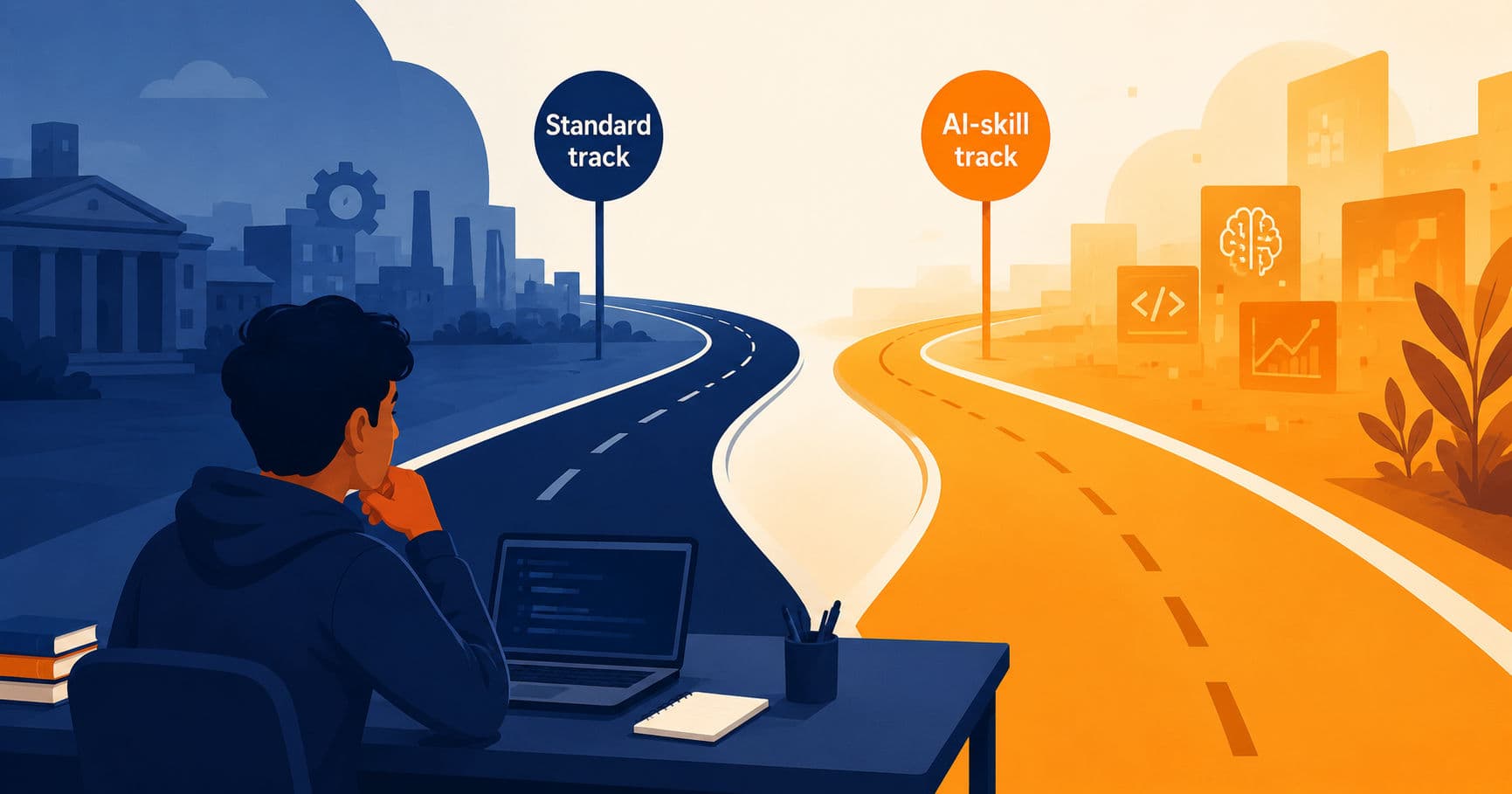
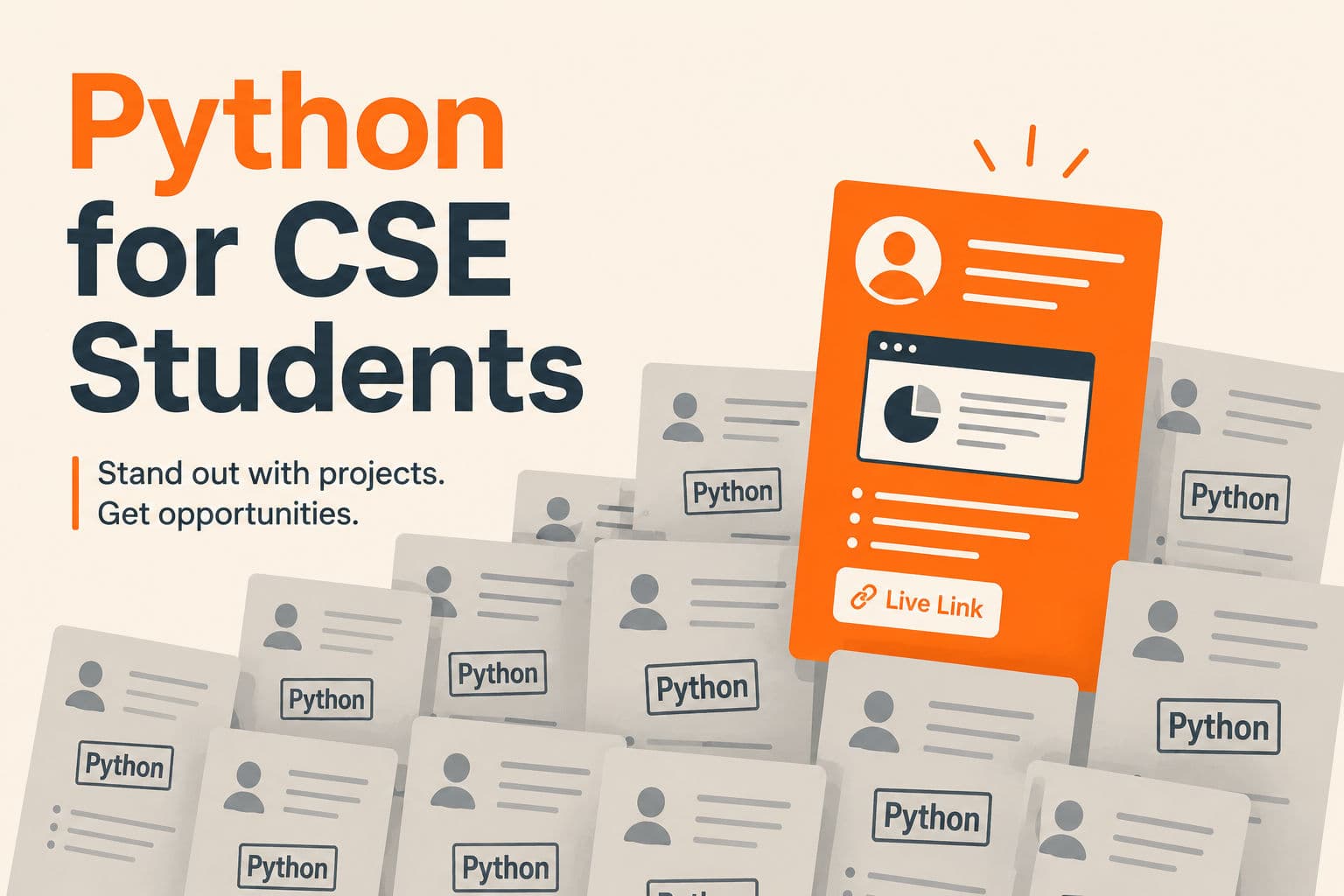
Python appears on a very large share of Indian CSE fresher resumes. Colleges teach it, every free course teaches it, and it is the first thing students list under skills. That saturation has a specific consequence: listing Python communicates that you meet the minimum, not that you stand out.
This is the part almost no article says, because most Python content is attached to a Python course.
What a recruiter sees when they read "Python" on a fresher resume is a claim with no evidence behind it. What changes that is one of four things:
-
A project with a live link and readable code. Not a tutorial clone. Something with a README, a commit history spread over more than one night, and a problem statement a non-programmer could understand.
-
Depth in a specific library, not breadth across many. "Built a data pipeline with pandas that cleans and joins three messy CSVs" says more than listing NumPy, pandas, Matplotlib, scikit-learn, TensorFlow, Django, and Flask in one line. A long library list reads as a syllabus, not experience.
-
Python plus something the market pairs it with. Python plus SQL. Python plus a cloud basic. Python plus real statistics. The pairing is what creates a role fit; Python alone maps to no specific role.
-
Evidence you can debug, not just write. Anyone can produce Python now, including AI assistants. Reading a traceback, isolating a failing case, and explaining why a fix works is the part that has become more valuable, not less.
The blunt framing: Python is your entry ticket to the room. What you built with it decides whether you get a chair.
Where Python is the wrong choice
Python is a general-purpose language, which does not mean it is the right tool everywhere. Knowing its limits is itself an interview signal, because most freshers cannot name a single one.
-
Performance-critical code. Python is significantly slower than C, C++, Rust, or Java for CPU-bound work. This is a design trade, not a defect, but it is real.
-
True CPU parallelism. The Global Interpreter Lock means standard Python threads do not execute Python bytecode in parallel on multiple cores. An experimental free-threaded build exists in recent versions, but it is not what you will be hired on, and you should still understand why the limitation existed.
-
Mobile app development. Android and iOS have their own ecosystems. Python is not a practical route into either.
-
Frontend web development. That is JavaScript and TypeScript territory. Python runs on the server, not in the browser.
-
Large enterprise systems at Indian service companies. Those are largely Java, and a Python-only profile does not map cleanly onto that hiring pipeline.
-
Embedded and systems programming. C dominates, with Rust growing. MicroPython exists for microcontrollers but is a niche, not the mainstream path.
Python in coding rounds: the speed problem nobody warns you about
Python is accepted in coding rounds at nearly every company, and it is a perfectly good interview language. There is one practical catch that costs students marks and almost no article mentions it.
Python executes more slowly than C++ or Java. On judged online assessments with tight time limits and large inputs, the same correct algorithm can time out in Python while passing in C++. You solved the problem, your logic was right, and you still lost the marks.
Two things follow from that.
Read input the fast way. For large inputs, input() is noticeably slower than reading from sys.stdin. In competitive and assessment contexts, use:
import sys
input = sys.stdin.readline
This one line has rescued more submissions than any algorithmic trick, and it is the direct Python equivalent of the Scanner versus BufferedReader problem Java students hit.
Know when to switch languages. If you are targeting companies whose assessments are known for tight limits, or you are doing serious competitive programming, learn enough C++ to write standard algorithms in it. You do not need to abandon Python. You need to not be surprised on test day.
For ordinary company interviews with a human on the call, Python's brevity is an advantage. You write less code, you make fewer syntax mistakes under pressure, and you spend more of the time talking about your approach. Use it there without hesitation.
The Python skills checklist that actually gets checked
Work down this list in order. The tiers matter: everything in Tier 1 is expected of every applicant, so it earns you nothing on its own. Tier 2 is where you start separating from the pile.
Tier 1 — Baseline (necessary, not sufficient)
-
Variables, data types, operators, and f-strings
-
Control flow: if, for, while, and break / continue
-
Lists, tuples, dictionaries, and sets, plus when each one is the right choice
-
Functions, arguments, default values, and return values
-
List and dictionary comprehensions
-
File reading and writing
-
Exception handling with try / except / finally
-
Classes, objects, init, and inheritance
-
Modules and imports
-
Reading a traceback and finding the failing line
Tier 2 — Differentiating (where you start standing out)
-
Virtual environments with venv, and a working requirements.txt
-
pandas: reading messy data, handling missing values, groupby, and merges
-
SQL alongside Python, including joins and basic indexes
-
Calling REST APIs with requests, and handling failures rather than assuming success
-
Writing tests with pytest, even just three of them
-
Git with meaningful commits spread over time
-
Following PEP 8 so your code reads like everyone else's
-
Building a REST API with FastAPI or Flask, and deploying it
-
Environment variables for secrets instead of hardcoded keys
-
Explaining time and space complexity of your own code
Tier 3 — Rare in freshers (genuine advantage)
-
Type hints and running mypy over your code
-
Logging instead of scattered print() calls
-
Understanding generators and why they save memory
-
Profiling a slow function and making it measurably faster
-
Packaging a project so someone else can install and run it
-
Knowing what the GIL is and why it constrains threading
-
Docker-ising a Python application
If you tick all of Tier 1 and half of Tier 2, you are ahead of most fresher applicants. Tier 3 items are the ones that make an interviewer sit up.
5 Python projects that prove more than a certificate
Each of these is chosen because it proves something specific. Build two or three, not all five, and finish them properly.
1. A real data cleaning and analysis project
Build: Take a genuinely messy public dataset — government open data, a Kaggle dataset with known quality problems, or scraped data of your own. Clean it, join it with a second source, and answer three specific questions with charts.
Proves: You can work with data that has missing values, inconsistent formats, and duplicates. This is what actual data work is, and it is the opposite of a tutorial dataset that loads cleanly.
The trap: Using the Iris or Titanic dataset. Every reviewer has seen them a thousand times and they signal that you followed a tutorial.
2. An automation script that saves a real person real time
Build: Something small that solves an actual problem near you. Consolidating attendance sheets from multiple sections. Scraping the college notice board and emailing new notices. Renaming and sorting a folder of files by content.
Proves: You identify problems and solve them, rather than completing exercises. This is the single most persuasive category, and it is the one students most often skip because it sounds unimpressive.
The trap: Building it and never running it again. Use it yourself for a month, then write in the README what broke.
3. A REST API with a database, deployed
Build: A FastAPI or Flask service with a handful of endpoints, a PostgreSQL database behind it, proper error responses, and environment variables for configuration. Deploy it on a free tier.
Proves: Backend capability. Also that you can think about failure cases, which most fresher projects ignore entirely.
The trap: Leaving your database URL or API key hardcoded in the repository. Reviewers notice, and it reads as carelessness with credentials.
4. A machine learning model with honest evaluation
Build: A classification or regression model on a dataset with real difficulty. Report precision, recall, and a confusion matrix, not only accuracy. Include a section on where the model fails.
Proves: You understand evaluation and overfitting rather than treating ML as a function you call.
The trap: Reporting 99% accuracy. On most real problems that number means you leaked the target into your features, and an interviewer will ask about it immediately.
5. A packaged command-line tool with tests
Build: Any small utility, packaged properly: a requirements.txt, a README with install and usage instructions, three or more pytest tests, and a clean project structure.
Proves: Engineering hygiene. Most fresher repositories have no tests and no way for anyone else to run them, so having both is a visible differentiator.
The trap: Skipping the README because the code "explains itself". It does not, and the README is the first thing a reviewer reads.
How long does it take to learn Python properly?
Reaching a working level in Python takes about two to three months at 8-10 hours a week. Reaching a level where your Python is worth putting on a resume takes about five to six months, because that includes projects.
A realistic breakdown:
| Stage | Time | What you can do at the end |
|---|---|---|
| Syntax and basics | 3-4 weeks | Write small programs without a tutorial open |
| Data structures in Python | 3-4 weeks | Solve 60-80 practice problems |
| One library in depth | 4 weeks | Real pandas work, or a working Flask/FastAPI app |
| First real project | 4 weeks | Something deployed with a README |
| Second project + polish | 4 weeks | A portfolio you can talk about |
The stage students underestimate is the third. They rush through Python basics, then discover they cannot manipulate a dataset without searching for every single function. Spend real time until writing a small data-cleaning script feels ordinary rather than a search-engine exercise.
Common mistakes CSE students make with Python
| Mistake | Why it happens | Fix |
|---|---|---|
| Listing eight libraries on a resume | It looks like broad skill | Name two you have actually used, with the project that proves it |
| pip install into system Python | Nobody taught virtual environments | Use venv per project and commit a requirements.txt |
| Using input() in judged tests | It is what tutorials teach | Use sys.stdin.readline for large inputs to avoid timing out |
| Toy datasets in every project | They load cleanly and feel productive | Use messy real data; the mess is the point |
| Reporting only accuracy in ML projects | It is the highest-looking number | Report precision, recall, and where the model fails |
| Hardcoding API keys in the repo | Convenience while building | Move them to environment variables before the first push |
| Watching tutorials without building | Video feels like progress | Pause and rebuild every example before continuing |
| Learning Python but skipping SQL | It feels like a separate subject | Learn joins early; almost every Python job tests SQL |
| Collecting Python certificates | They are easy to acquire | Build one deployed project instead |
| Assuming Python covers everything | One language did cover four years of coursework | Pair it with SQL, and add C++ or Java if your targets need it |
Frequently asked questions
Is Python enough to get a job as a CSE fresher?
Python alone is not enough. Companies hiring Python freshers expect the language plus data structures, SQL, Git, and at least one project you built and can explain in detail. Python appears on most CSE fresher resumes, so it establishes that you meet the minimum rather than making you stand out.
Should CSE students learn Python in first year?
Yes. Python is the best first language for most CSE students because its readable syntax and lack of manual memory management let you write working programs quickly. Starting in first year gives you three years to build projects on top of it, which is where the actual hiring value comes from.
Is Python good for placements in India?
Python is accepted in coding rounds at nearly every Indian company and is strong for data, AI, automation, and startup backend roles. It is less directly aligned with mass-recruiter service companies, whose client work leans heavily on Java. Check what your specific target companies use before committing to Python alone.
Which is better for a CSE student, Python or C++?
They serve different purposes. Python is better for learning, data work, AI, automation, and everyday development speed. C++ is better for competitive programming and performance-critical code, and it runs faster in time-limited online assessments. Many students learn Python first and add enough C++ for coding tests.
How long does it take to learn Python?
Two to three months at 8-10 hours a week gets you to a working level where you can write programs without a tutorial open. Reaching a resume-worthy level takes around five to six months, because that includes building and deploying two real projects rather than only learning syntax.
Which Python version should I learn?
Learn on a currently supported Python 3 release. Python 2 has been unsupported for years and no longer appears in hiring. Check the official Python developer guide for which versions are receiving security support, and avoid learning only whatever version your college lab happens to have installed.
Do I need to learn Django or Flask?
Only if you want backend web development. For data, analytics, or machine learning roles, pandas and SQL matter far more than any web framework. If you do want backend, pick one framework and build something real with it rather than sampling both.
Will AI tools make Python skills useless?
No, but they change what is valuable. AI assistants write basic Python very well, so "I can write simple scripts" is now a weak claim. What holds value is reading unfamiliar code, debugging failures, choosing between approaches, and explaining why a solution works, all of which require actually understanding the language.
Is Python worth learning if my college teaches Java?
Yes. Learn your college's language well enough to clear coursework and campus assessments, then add Python for projects, data work, and automation. Most working developers use two or three languages, and having both on your resume with real projects behind each is stronger than depth in either alone.
Conclusion
Python is worth your time, and for most CSE students it is the right place to start. The part that decides your outcome is what happens after the syntax, because Python by itself now says only that you met the minimum.
Pick two projects from the list above, finish them properly with a README and a live link, and pair Python with SQL. That combination puts you ahead of most applicants who listed eight libraries and built none of them.
Start this week with Tier 1 of the checklist, and give yourself until month three before you judge whether it is working.
Check - Python Roadmap for Beginners in 2026 (Complete Guide)