Python continues to dominate the programming world, making it one of the best languages to learn in 2026. Whether you want to become a software developer, data scientist, AI engineer, automation expert, or cybersecurity professional, Python is an excellent starting point.
This Python Roadmap for Beginners in 2026 explains every stage of learning Python—from writing your first program to building real-world applications. If you follow this roadmap consistently, you can become job-ready within six months.
Why Learn Python in 2026?
Python has remained one of the world's most popular programming languages because it is simple, powerful, and used across almost every technology industry.
Python is used in:
- Artificial Intelligence
- Machine Learning
- Data Science
- Web Development
- Automation
- Cybersecurity
- Cloud Computing
- Robotics
- IoT
- Game Development
Why Python is the Best Choice
| Feature | Benefit |
|---|---|
| Easy Syntax | Perfect for beginners |
| Huge Community | Millions of developers worldwide |
| High Demand | Thousands of job openings |
| Cross Platform | Works on Windows, Linux, and macOS |
| Open Source | Completely free |
| Rich Libraries | Saves development time |
Who Should Learn Python?
The Python Roadmap for Beginners in 2026 is suitable for:
- Engineering students
- Computer Science students
- BCA and MCA students
- Working professionals
- Career switchers
- Freelancers
- Data analysts
- AI enthusiasts
- Automation engineers
- Beginners with zero coding knowledge
Even if you have never written a single line of code, Python is one of the easiest languages to start with.
Career Opportunities After Learning Python
Python opens doors to multiple career paths.
| Career | Average Demand |
|---|---|
| Python Developer | Very High |
| Backend Developer | High |
| AI Engineer | Very High |
| Machine Learning Engineer | Very High |
| Data Scientist | Very High |
| Automation Engineer | High |
| DevOps Engineer | High |
| Cybersecurity Analyst | Growing |
| Data Analyst | High |
Learning Python also helps you prepare for cloud technologies, automation, and modern software engineering roles.
Python Roadmap for Beginners in 2026
Below is the complete roadmap.
Python Basics
      ↓
Variables & Data Types
      ↓
Operators
      ↓
Conditions
      ↓
Loops
      ↓
Functions
      ↓
Collections
      ↓
Modules
      ↓
Exception Handling
      ↓
File Handling
      ↓
Object-Oriented Programming
      ↓
Virtual Environment
      ↓
Git & GitHub
      ↓
SQL Basics
      ↓
REST APIs
      ↓
Testing
      ↓
Choose a Specialization
      ↓
Projects
      ↓
Internship / Job
Step 1: Learn Python Basics
Begin by understanding the language.
Topics include:
- Installing Python
- Running Python programs
- Using VS Code
- Python IDLE
- Comments
- Print function
- Input function
- Basic syntax
Practice writing simple programs every day.
Step 2: Variables and Data Types
Variables store information.
Example:
- Integer
- Float
- String
- Boolean
Learn:
- Variable naming
- Constants
- Type conversion
- User input
Understanding data types builds a strong programming foundation.
Step 3: Operators
Operators help perform calculations.
Learn:
- Arithmetic Operators
- Comparison Operators
- Assignment Operators
- Logical Operators
- Membership Operators
- Identity Operators
- Bitwise Operators
Practice solving mathematical problems.
Step 4: Conditional Statements
Programs make decisions using conditions.
Topics:
- if
- else
- elif
- Nested conditions
Build small applications like:
- Grade calculator
- Age checker
- Login validation
Step 5: Loops
Loops repeat tasks automatically.
Learn:
- for loop
- while loop
- break
- continue
- pass
- range()
Projects:
- Multiplication table
- Number guessing game
- Pattern printing
Step 6: Functions
Functions make code reusable.
Topics:
- Creating functions
- Parameters
- Arguments
- Return values
- Lambda functions
- Recursion
Functions are one of the most important concepts you'll master on this journey.
Step 7: Python Collections
Master built-in data structures.
Learn:
- Lists
- Tuples
- Dictionaries
- Sets
Practice:
- Sorting
- Searching
- Adding
- Removing
- Iterating
Step 8: Modules and Packages
Instead of writing everything yourself, Python provides modules.
Popular modules:
- math
- random
- datetime
- os
- sys
Also learn how to install packages using pip.
Step 9: Exception Handling
Programs often encounter errors.
Learn:
- try
- except
- finally
- raise
Proper exception handling makes software reliable.
Step 10: File Handling
Learn to work with files.
Topics:
- Read files
- Write files
- CSV
- JSON
Mini projects:
- Student management system
- Notes application
- Expense tracker
Step 11: Object-Oriented Programming (OOP)
OOP is essential for real-world development.
Learn:
- Classes
- Objects
- Constructors
- Inheritance
- Polymorphism
- Encapsulation
- Abstraction
Mastering OOP is an important milestone in your Python learning journey.
Step 12: Virtual Environments
Every Python project should have its own environment.
Learn:
- venv
- pip
- requirements.txt
Benefits:
- Dependency management
- Project isolation
- Cleaner development
Step 13: Git and GitHub
Version control is essential.
Topics:
- Git installation
- Repository
- Commit
- Push
- Pull
- Branch
- Merge
- Pull Request
GitHub also acts as your developer portfolio.
Step 14: SQL Basics
Python works closely with databases.
Learn:
- SELECT
- INSERT
- UPDATE
- DELETE
- JOIN
- GROUP BY
- ORDER BY
Practice using SQLite or MySQL.
Step 15: APIs
Modern applications communicate using APIs.
Learn:
- REST API
- JSON
- GET
- POST
- PUT
- DELETE
Practice using Python's requests library.
Step 16: Testing
Professional developers test code.
Learn:
- unittest
- pytest
- Assertions
- Test cases
Testing improves software quality.
Popular Python Frameworks and Libraries
Choosing the right framework depends on your career goals.
| Framework | Use Case |
|---|---|
| Django | Large web applications |
| Flask | Small web projects |
| FastAPI | High-performance APIs |
| NumPy | Numerical computing |
| Pandas | Data analysis |
| Matplotlib | Data visualization |
| TensorFlow | Artificial Intelligence |
| PyTorch | Deep Learning |
Choose Your Career Path
Web Development
Learn:
- Django
- Flask
- FastAPI
- HTML
- CSS
- JavaScript
Projects:
- Blog website
- Portfolio
- E-commerce site
Data Science
Learn:
- NumPy
- Pandas
- Matplotlib
- Statistics
Projects:
- Sales dashboard
- Data visualization
- CSV analysis
Machine Learning
Learn:
- Scikit-learn
- TensorFlow
- PyTorch
Projects:
- House price prediction
- Spam detection
- Recommendation system
Automation
Python is excellent for automation.
Projects:
- Excel automation
- Email automation
- PDF generation
- Web scraping
Best Free Resources
| Website | Purpose |
|---|---|
| Python.org | Official documentation |
| W3Schools | Basics |
| GeeksforGeeks | Tutorials |
| freeCodeCamp | Free courses |
| YouTube | Video learning |
| | Kaggle | Data Science practice | | GitHub | Open-source projects |
Beginner Projects
- Calculator
- Number Guessing Game
- Password Generator
- Quiz App
- To-do List
- Student Management System
- Weather App
- Currency Converter
Intermediate Projects
- Expense Tracker
- Library Management System
- Chat Application
- Portfolio Website
- URL Shortener
- Blog CMS
Advanced Projects
- AI Chatbot
- Face Recognition
- E-commerce Website
- Hospital Management System
- Online Compiler
- Attendance System
Projects are the fastest way to strengthen the concepts you've learned so far.
Common Mistakes Beginners Make
Avoid these common errors:
- Skipping Python fundamentals
- Memorising code instead of understanding logic
- Not practising daily
- Ignoring debugging
- Avoiding Git
- Not building projects
- Copy-pasting code without learning
- Giving up after errors
Python Interview Preparation Tips
To prepare for interviews:
- Practice coding daily.
- Solve logical programming questions.
- Revise OOP concepts.
- Understand time complexity basics.
- Learn SQL queries.
- Build GitHub projects.
- Explain your projects clearly.
- Solve beginner-level coding challenges consistently.
Python Salary Insights (2026)
Salary depends on skills, projects, and experience.
| Experience | Expected Annual Salary |
|---|---|
| Fresher | ₹4–8 LPA |
| 1–3 Years | ₹7–14 LPA |
| 3–5 Years | ₹12–20 LPA |
| Senior Developer | ₹20+ LPA |
| AI/ML Engineer | ₹15–35+ LPA |
Strong portfolios and real-world projects can significantly improve job opportunities.
6-Month Python Learning Plan
| Month | Focus |
|---|---|
| Month 1 | Python basics, variables, operators, loops |
| Month 2 | Functions, collections, OOP, file handling |
| Month 3 | Git, GitHub, SQL, APIs, testing |
| Month 4 | Django or Flask, build web applications |
| Month 5 | Projects, deployment, portfolio development |
| Month 6 | Interview preparation, open-source contributions, job applications |
Consistency is more important than speed. Aim to code every day, even if it is only for one hour.
Join the HelloEngineers Community
Learning alone can sometimes feel challenging. Joining a developer community allows you to ask questions, share projects, receive feedback, and stay motivated.
HelloEngineers is a growing community where engineering students and beginners can:
- Learn programming with peers
- Ask coding doubts
- Share Python projects
- Participate in technical discussions
- Discover internships and career opportunities
- Connect with other learners across India
Being part of a learning community can accelerate your progress and help you stay consistent.
Internal Linking Suggestions
Link this article with related guides such as:
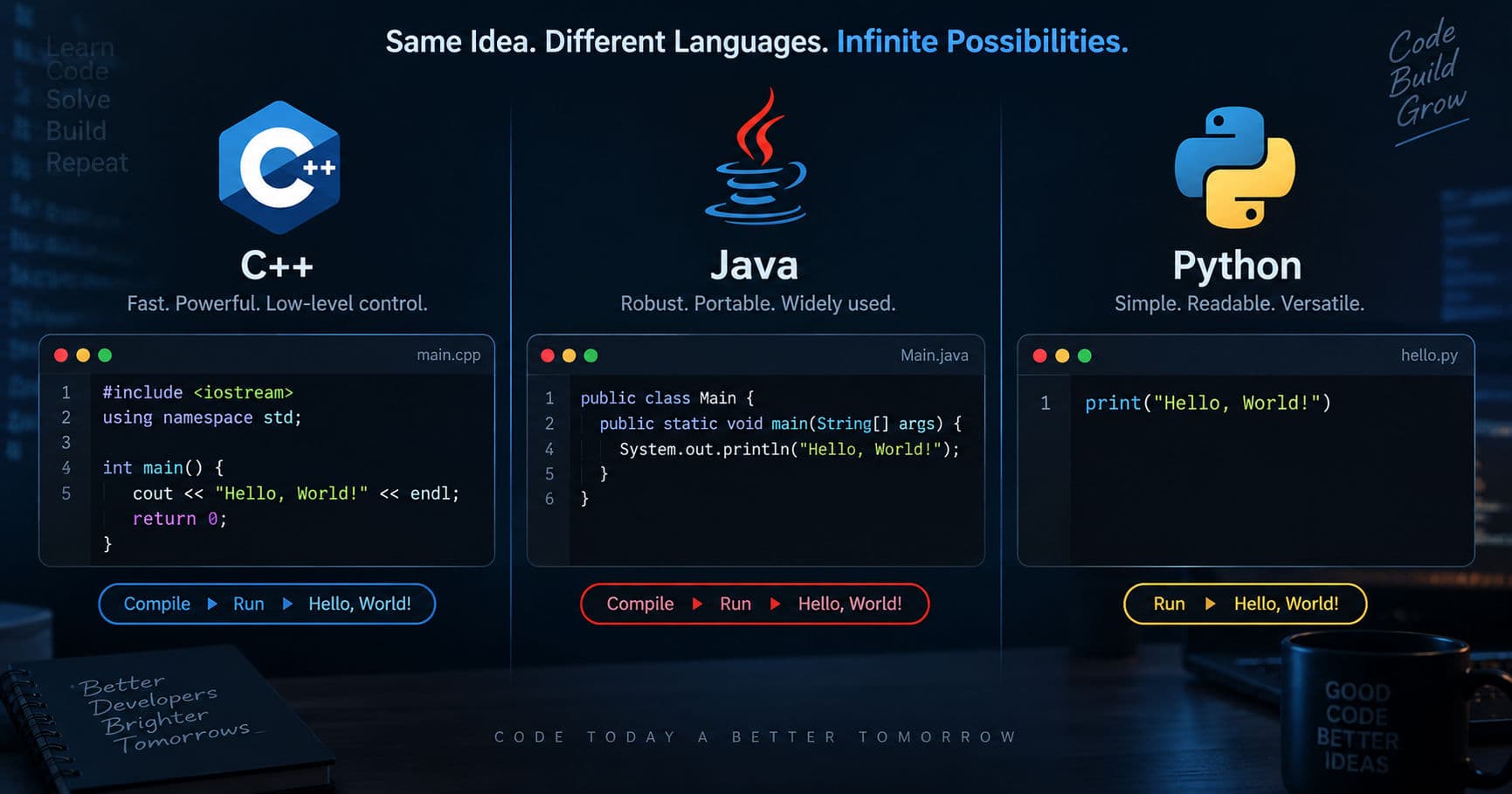
- C++ vs Java vs Python: Which Language Should You Learn First?
- Data Structures and Algorithms (DSA) Roadmap
- Object-Oriented Programming (OOP) Concepts Explained
- JavaScript ES6 Features Every Developer Should Know
- Top 50 Java Interview Questions with Answers
- Top 100 SQL Interview Questions
- Recursion Explained with Real Examples
Frequently Asked Questions (FAQs)
Is Python good for beginners in 2026?
Yes. Python is one of the easiest programming languages to learn because of its clean syntax and extensive learning resources.
How long does it take to learn Python?
With regular practice, beginners can learn the fundamentals in two to three months and become job-ready in about six months.
Do I need mathematics to learn Python?
Basic mathematics is enough for general Python programming. Advanced mathematics is mainly required for fields like machine learning and data science.
Which IDE is best for Python?
Visual Studio Code and PyCharm are among the most popular choices for beginners and professionals.
Should I learn Python before Java?
For most beginners, Python is easier to start with because it has simpler syntax and faster learning curves.
Can I get a job after learning Python?
Yes. Building strong projects, understanding core concepts, learning Git and SQL, and preparing for interviews can help you secure internships and entry-level developer roles.
Conclusion
Following this Python Roadmap for Beginners in 2026 gives you a clear path from beginner to professional developer. Start with Python fundamentals, strengthen your understanding through daily practice, build practical projects, learn Git, SQL, APIs, and testing, then choose a specialization such as web development, data science, artificial intelligence, or automation.
Remember that becoming a skilled Python developer is not about completing tutorials—it's about writing code consistently, solving real problems, and improving with every project. Stay curious, keep building, contribute to open-source projects, and engage with communities like HelloEngineers to learn faster and grow alongside other aspiring developers.