Introduction
If you've just started learning to code, you might have encountered the word "recursion" and felt confused. Don't worry. Many beginners find it intimidating at first, but it's actually one of the most elegant problem-solving techniques in programming. Once you understand how it works, you'll see it everywhere in computer science.
This guide will walk you through recursion from the very beginning, with simple examples you can relate to, code demonstrations in three popular languages, and practical techniques to master this essential concept.
What is Recursion?
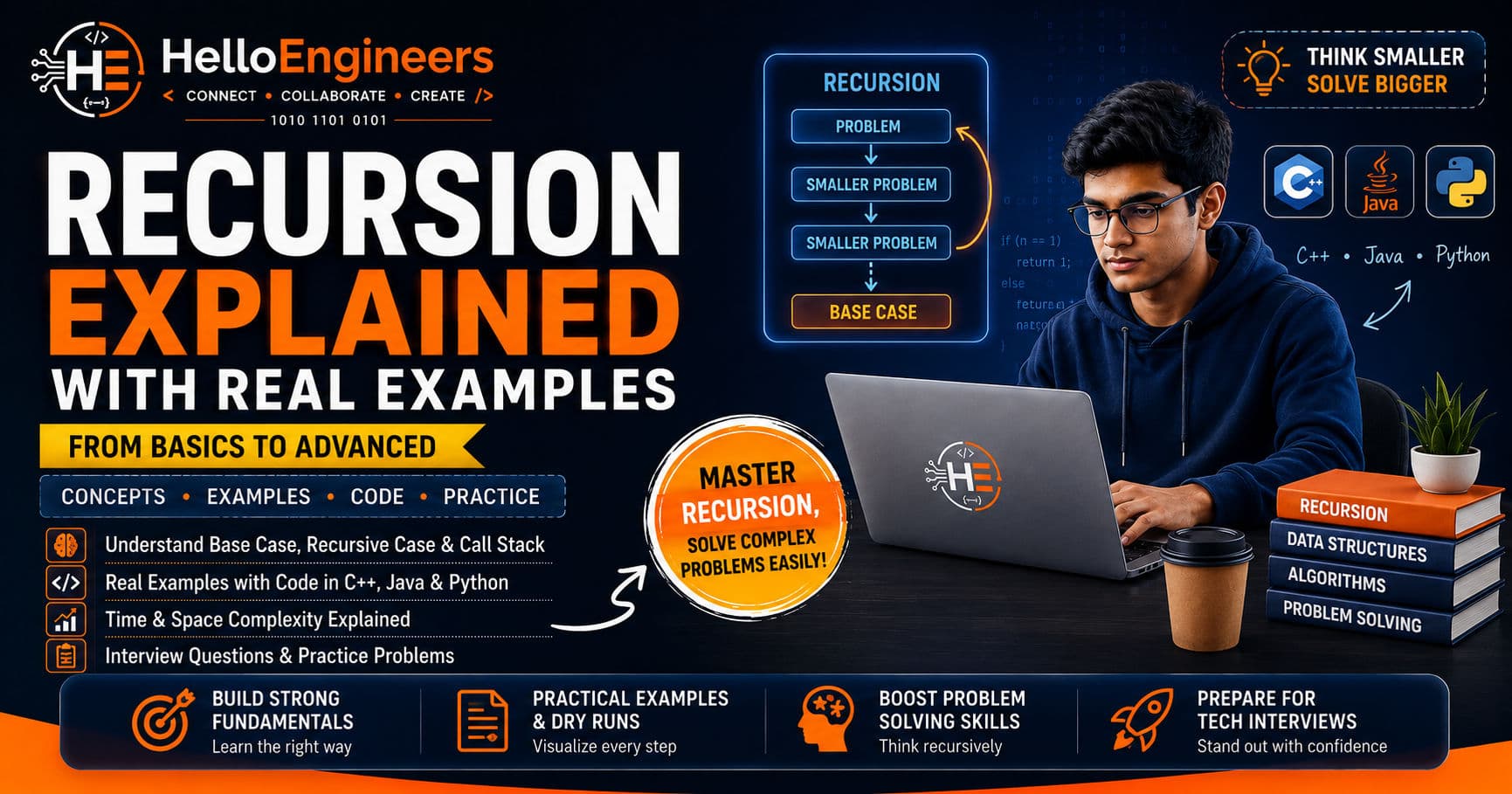
Recursion happens when a function calls itself to solve smaller instances of the same problem until it reaches a simple case it can solve directly.
Think of it like this: Imagine you're looking for your keys in your messy room. You decide to organize everything first. You pick up a pile of stuff and think, "I need to organize this pile." Then you pick up the top item from that pile and go through the same process of organizing smaller and smaller piles, until you're left with just one item (which is already organized). By solving each tiny pile, you eventually organize everything.
That's recursion in action. A complex problem gets broken down into simpler versions of itself.
Why is Recursion Important?
Recursion matters in programming for several reasons:
Problem Clarity: Some problems have a recursive nature by design. Writing a recursive solution feels natural for these problems because your code reflects the problem structure.
Code Elegance: Recursive solutions are often shorter and clearer than their iterative counterparts, making code easier to understand and maintain.
Data Structures: Many data structures like trees and graphs are inherently recursive. Working with them requires understanding recursion.
Algorithm Design: Many advanced algorithms depend on recursion, including divide-and-conquer strategies, dynamic programming, and backtracking.
Interview Preparation: Recursion problems appear regularly in technical interviews. Understanding this concept well gives you a significant advantage.
The Two Essential Components
Every recursive function must have two components working together:
Base Case
The base case is the stopping condition. It tells the function when to stop calling itself. Without a base case, your function would call itself forever, causing a stack overflow error.
Think of the base case as the answer to your simplest version of the problem. If you're calculating a factorial, the base case is: "The factorial of 0 is 1" (or the factorial of 1 is 1). You don't need to break this down further.
Recursive Case
This is where the function calls itself with a simpler version of the original problem. The key requirement is that each recursive call must move toward the base case. The problem must get progressively simpler.
If you're calculating the factorial of 5, the recursive case says: "The factorial of 5 equals 5 times the factorial of 4." Then you call the same function with 4, which calls it with 3, and so on, until you reach the base case.
Understanding the Function Call Stack
When your program executes, each function call gets placed on a stack. This is a data structure that works like a stack of plates. The last plate you put on is the first one you take off (Last In, First Out).
Let's trace what happens when you calculate factorial(4):
Call 1: factorial(4) - added to stack, waits for factorial(3)
  Call 2: factorial(3) - added to stack, waits for factorial(2)
    Call 3: factorial(2) - added to stack, waits for factorial(1)
      Call 4: factorial(1) - base case reached! Returns 1
    Call 3 continues: 2 × 1 = 2, returns to stack
  Call 2 continues: 3 × 2 = 6, returns to stack
Call 1 continues: 4 × 6 = 24, returns result
The stack filled up as we went deeper into calls, then emptied as we came back up. Understanding this helps you recognize why deep recursion can cause stack overflow errors when your computer runs out of memory for storing function calls.
Simple Example: Calculating Factorial
Let's start with factorial, the classic recursion example.
Definition: The factorial of a number n (written as n!) is the product of all positive integers less than or equal to n. So 5! = 5 × 4 × 3 × 2 × 1 = 120.
Recursive Thinking: Instead of multiplying all these numbers, think recursively: "5! equals 5 times 4!" And "4! equals 4 times 3!" Continue this pattern until you reach "1! equals 1" (your base case).
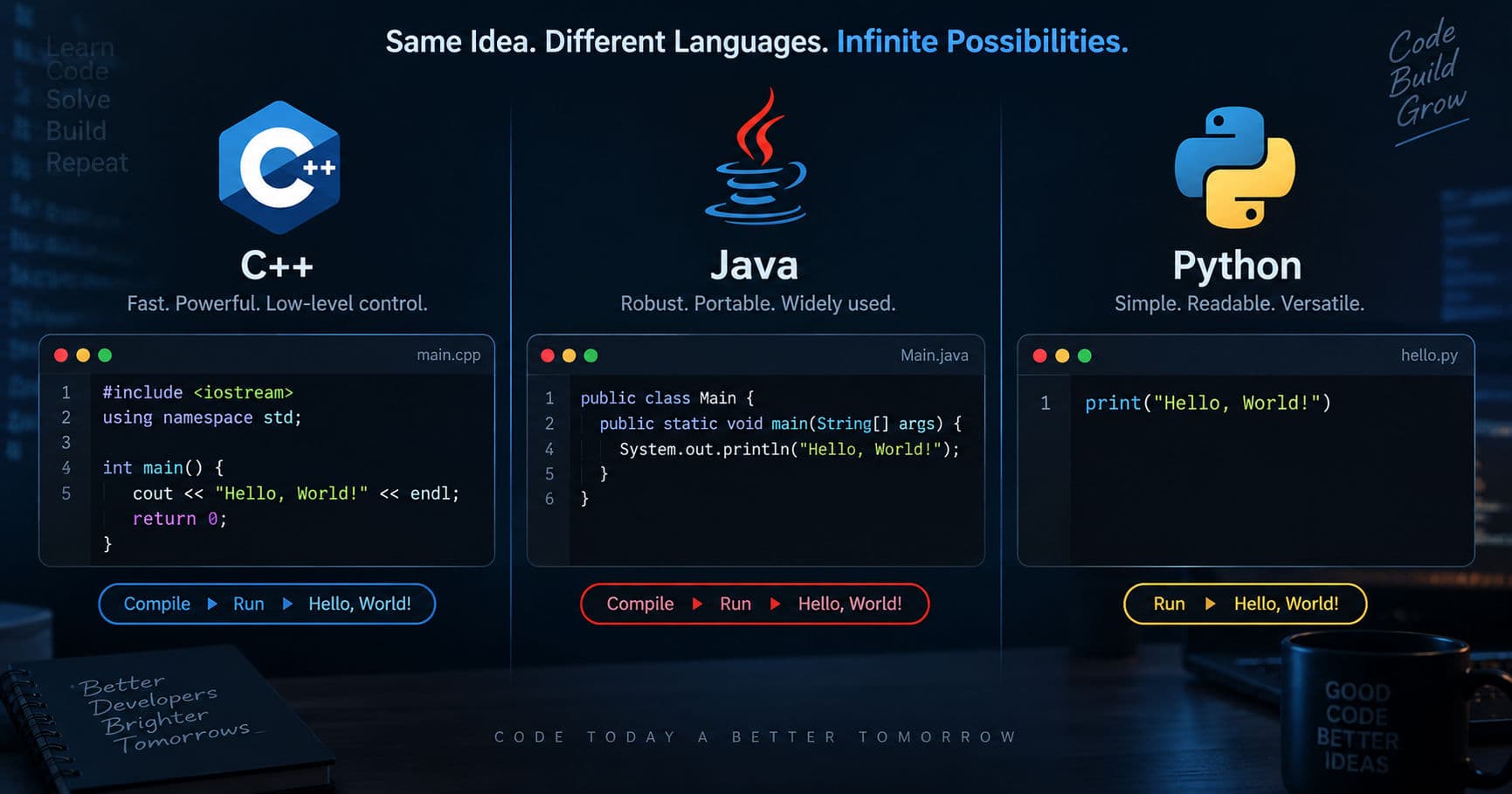
Python Implementation
def factorial(n):
    # Base case: when to stop
    if n == 1:
        return 1
    # Recursive case: break problem into smaller version
    else:
        return n * factorial(n - 1)

print(factorial(5))  # Output: 120
Java Implementation
public static int factorial(int n) {
    // Base case
    if (n == 1) {
        return 1;
    }
    // Recursive case
    return n * factorial(n - 1);
}

public static void main(String[] args) {
    System.out.println(factorial(5));  // Output: 120
}
C++ Implementation
# include <iostream>
using namespace std;

int factorial(int n) {
    // Base case
    if (n == 1) {
        return 1;
    }
    // Recursive case
    return n * factorial(n - 1);
}

int main() {
    cout << factorial(5) << endl;  // Output: 120
    return 0;
}
More Practical Examples
Fibonacci Series
The Fibonacci sequence starts with 0 and 1, and each number after that is the sum of the previous two numbers: 0, 1, 1, 2, 3, 5, 8, 13, 21...
This is naturally recursive because each number depends on the two before it.
Python:
def fibonacci(n):
    if n <= 1:
        return n
    return fibonacci(n - 1) + fibonacci(n - 2)

print(fibonacci(6))  # Output: 8

Sum of Array Elements
Instead of using a loop, calculate the sum recursively:
Python:
def sum_array(arr, index=0):
    # Base case: reached end of array
    if index == len(arr):
        return 0
    # Recursive case: current element + sum of rest
    return arr[index] + sum_array(arr, index + 1)

print(sum_array([1, 2, 3, 4, 5]))  # Output: 15
String Reversal
Reverse a string by calling the function on increasingly smaller strings:
Python:
def reverse_string(s):
    # Base case: empty or single character
    if len(s) <= 1:
        return s
    # Recursive case: last character + reverse of rest
    return s[-1] + reverse_string(s[:-1])

print(reverse_string("hello"))  # Output: "olleh"
Palindrome Check
Check if a word reads the same forwards and backwards:
Python:
def is_palindrome(s):
    # Base case: single character or empty
    if len(s) <= 1:
        return True
    # Check if first and last match, then check middle part
    if s[0] != s[-1]:
        return False
    return is_palindrome(s[1:-1])

print(is_palindrome("racecar"))  # Output: True
Binary Search
Efficiently find an element in a sorted array:
Python:
def binary_search(arr, target, left=0, right=None):
    if right is None:
        right = len(arr) - 1

    # Base case: element not found
    if left > right:
        return -1

    mid = (left + right) // 2

    # Base case: element found
    if arr[mid] == target:
        return mid
    # Recursive case: search right half
    elif arr[mid] < target:
        return binary_search(arr, target, mid + 1, right)
    # Recursive case: search left half
    else:
        return binary_search(arr, target, left, mid - 1)

sorted_arr = [1, 3, 5, 7, 9, 11, 13]
print(binary_search(sorted_arr, 7))  # Output: 3
Recursion vs Iteration: Which Should You Use?
Both recursion and iteration (using loops) can solve the same problems. Understanding when to use each is important.
| Aspect | Recursion | Iteration |
|---|---|---|
| Code Clarity | Often more elegant and natural | More straightforward for simple problems |
| Memory Usage | Higher (function call stack) | Lower (single loop variable) |
| Performance | Slower due to function call overhead | Faster execution |
| Stack Overflow Risk | Yes, with deep recursion | No risk of stack overflow |
| Best For | Trees, graphs, divide-and-conquer | Repetitive tasks, large datasets |
| Debugging | Harder to trace through calls | Easier to follow |
When to use recursion: Working with tree/graph structures, solving divide-and-conquer problems, or when the recursive solution is significantly clearer.
When to use iteration: Processing large amounts of data, when performance is critical, or when you need to avoid potential stack overflow.
Time and Space Complexity Analysis
Factorial Example
- Time Complexity: O(n) - We make n function calls
- Space Complexity: O(n) - Stack stores n function calls
Fibonacci Example (naive recursive)
- Time Complexity: O(2^n) - Exponentially slow because we recalculate same values
- Space Complexity: O(n) - Call stack depth is n
For Fibonacci, a recursive solution without optimization is very inefficient. Using memoization (caching results) can reduce time complexity to O(n).
Binary Search
- Time Complexity: O(log n) - We eliminate half the data with each call
- Space Complexity: O(log n) - Call stack depth is logarithmic
Common Mistakes to Avoid
Missing or Incorrect Base Case: This causes infinite recursion. Always verify your base case stops the recursion.
Not Moving Toward Base Case: Each recursive call must solve a simpler version of the problem. If your recursive case doesn't move toward the base case, you'll never stop.
Not Handling Edge Cases: Consider what happens with empty inputs, zero, negative numbers, or single elements.
Stack Overflow: If your recursion depth exceeds your system's stack size, your program crashes. For deep problems, use iteration instead.
Redundant Calculations: The Fibonacci example shows this problem. Calling fibonacci(5) calculates fibonacci(3) multiple times. Use memoization to cache results.
Debugging Recursive Functions
Add Print Statements: Track when functions are called and what values are passed.
def factorial(n, depth=0):
    indent = "  " * depth
    print(f"{indent}factorial({n}) called")

    if n == 1:
        print(f"{indent}Base case reached, returning 1")
        return 1

    result = n * factorial(n - 1, depth + 1)
    print(f"{indent}factorial({n}) returning {result}")
    return result
Use a Debugger: Step through your code line by line to watch the call stack build and unwind.
Test with Small Inputs: Start with n=1 or n=2, then gradually increase to understand the pattern.
Real-World Applications
File System Navigation: When traversing directory structures, you need to recursively explore folders within folders.
Tree and Graph Algorithms: Most tree operations (searching, inserting, traversing) use recursion naturally.
Parsing and Compilers: Programming language compilers parse code recursively based on language grammar rules.
Game Development: Backtracking algorithms help solve puzzles and make AI decisions in games.
Machine Learning: Recursive algorithms appear in decision trees, where data is split recursively to create branches.
Dynamic Programming: Many DP solutions start as recursive solutions with memoization.
Interview Questions on Recursion
1. What is recursion?
Recursion is a technique where a function calls itself to solve smaller instances of a problem.
2. What is a base case?
It is the condition that stops further recursive calls.
3. What happens without a base case?
The function may continue indefinitely until the program encounters a stack overflow.
4. What is the call stack?
It is the memory structure used to keep track of active function calls and their local information.
5. Is recursion faster than iteration?
Not necessarily. Recursive calls have function-call overhead and may require additional stack memory.
6. Can every recursive solution be converted to iteration?
In principle, many can, although the iterative version may require an explicit stack or a different design.
7. Why is recursive Fibonacci inefficient?
The naive version repeatedly calculates the same Fibonacci values.
8. What is tail recursion?
Tail recursion occurs when the recursive call is the final operation performed by the function.
9. What is backtracking?
Backtracking recursively explores choices and reverses a choice when that path cannot produce a valid solution.
10. Where is recursion commonly used?
It is frequently used with trees, graphs, divide-and-conquer algorithms, backtracking, file systems, and dynamic programming.
Practice Problems for Beginners
- Calculate power(base, exponent)
- Find the greatest common divisor using Euclidean algorithm
- Check if a number is prime
- Generate all subsets of a set
- Implement quick sort or merge sort
- Flatten a nested list/array
- Find the maximum element in an array
Leveling Up Your Skills
Understanding recursion deeply takes practice. The best approach is to start with simple problems, write out the trace on paper, and gradually tackle more complex ones. Platforms like HelloEngineers offer structured learning paths where you can practice recursion problems with immediate feedback, discuss different approaches with other learners, and prepare for technical interviews with similar questions you'll encounter.
Working through problems on platforms that provide community support helps you see how experienced programmers think through recursive problems differently. You also get exposure to edge cases and optimizations you might miss learning alone.
Key Takeaways
Recursion is a powerful tool when used appropriately. Remember these essential points:
- Every recursive function needs a base case and a recursive case
- The recursive case must move toward the base case
- Recursion trades clarity for performance and memory usage
- Understanding the call stack helps you visualize how recursion works
- Not every problem benefits from recursion; sometimes iteration is better
- Practice with simple examples before tackling complex problems
- Consider time and space complexity when choosing your approach
Recursion might feel strange at first, but with practice, you'll develop intuition for recursive thinking. This skill becomes invaluable as you progress in your programming journey and encounter more complex algorithms and data structures.
The key is to start small, trace through examples by hand, and gradually build confidence. Before long, recursive thinking will become second nature, and you'll recognize recursive patterns in problems immediately.
Final Thoughts
Mastering recursion is a milestone in your programming education. It opens doors to understanding sophisticated algorithms and data structures that power modern software. Take time to practice, experiment with different approaches, and don't hesitate to revisit concepts when they feel unclear.
As you continue learning, remember that the best programmers aren't those who know everything immediately. They're the ones who practice consistently and learn from each problem they encounter. Keep coding, keep learning, and enjoy the journey of becoming a better programmer.
Frequently Asked Questions
1. Is recursion difficult for beginners?
Recursion can feel confusing initially because a function calls itself. Start with simple problems such as factorial, counting, and reversing a string. Once you understand the base case, recursive case, and call stack, more advanced problems become easier to follow.
2. What is the most important rule in recursion?
Every recursive function needs a clear base case and must make progress toward it. If either is missing, the function may continue calling itself until a stack overflow occurs.
3. Why does recursion use more memory than a loop?
Each active recursive call creates a stack frame containing information needed to resume that call later. A loop usually reuses the same function frame, so a simple iterative solution often requires less auxiliary memory.
4. Is recursion always slower than iteration?
No. It depends on the algorithm and implementation. Recursion can have function-call overhead, but a recursive divide-and-conquer algorithm can still be highly efficient. The important thing is to compare the actual time and space complexity rather than assuming one approach is always faster.
5. Can recursion cause a stack overflow?
Yes. Very deep recursion can exhaust the program's call stack. This can happen when the recursion depth is extremely large or when a programming error prevents the base case from being reached.
6. What is the difference between recursion and backtracking?
Recursion is the general technique of a function solving a problem by calling itself. Backtracking is a problem-solving strategy that often uses recursion to explore choices, undo unsuccessful choices, and try alternatives. N-Queens, Sudoku, and maze problems are common examples.
7. Why is recursive Fibonacci inefficient?
The basic recursive Fibonacci solution calculates the same Fibonacci values many times. For example, fib(3) can be reached through multiple branches of fib(5). Memoization stores results that have already been calculated and can reduce the time complexity from exponential to O(n).
8. When should I choose recursion instead of a loop?
Recursion is a strong choice when the problem naturally has nested or hierarchical structure, such as trees, directory systems, divide-and-conquer algorithms, and backtracking. For simple repeated calculations, a loop is often easier to understand and more memory-efficient.
9. How can I get better at solving recursive problems?
Do not begin by trying to trace the entire program. First identify the smallest input and write the base case. Then ask how the answer for a smaller input can help solve the current input. Practice by manually drawing the call stack and tracing small examples before writing the final code.
10. Is recursion important for coding interviews?
Yes. Interviewers commonly use recursion to test problem decomposition, complexity analysis, tree and graph traversal, divide-and-conquer thinking, and backtracking. A solid understanding of recursion also makes topics such as dynamic programming and DFS easier to learn.